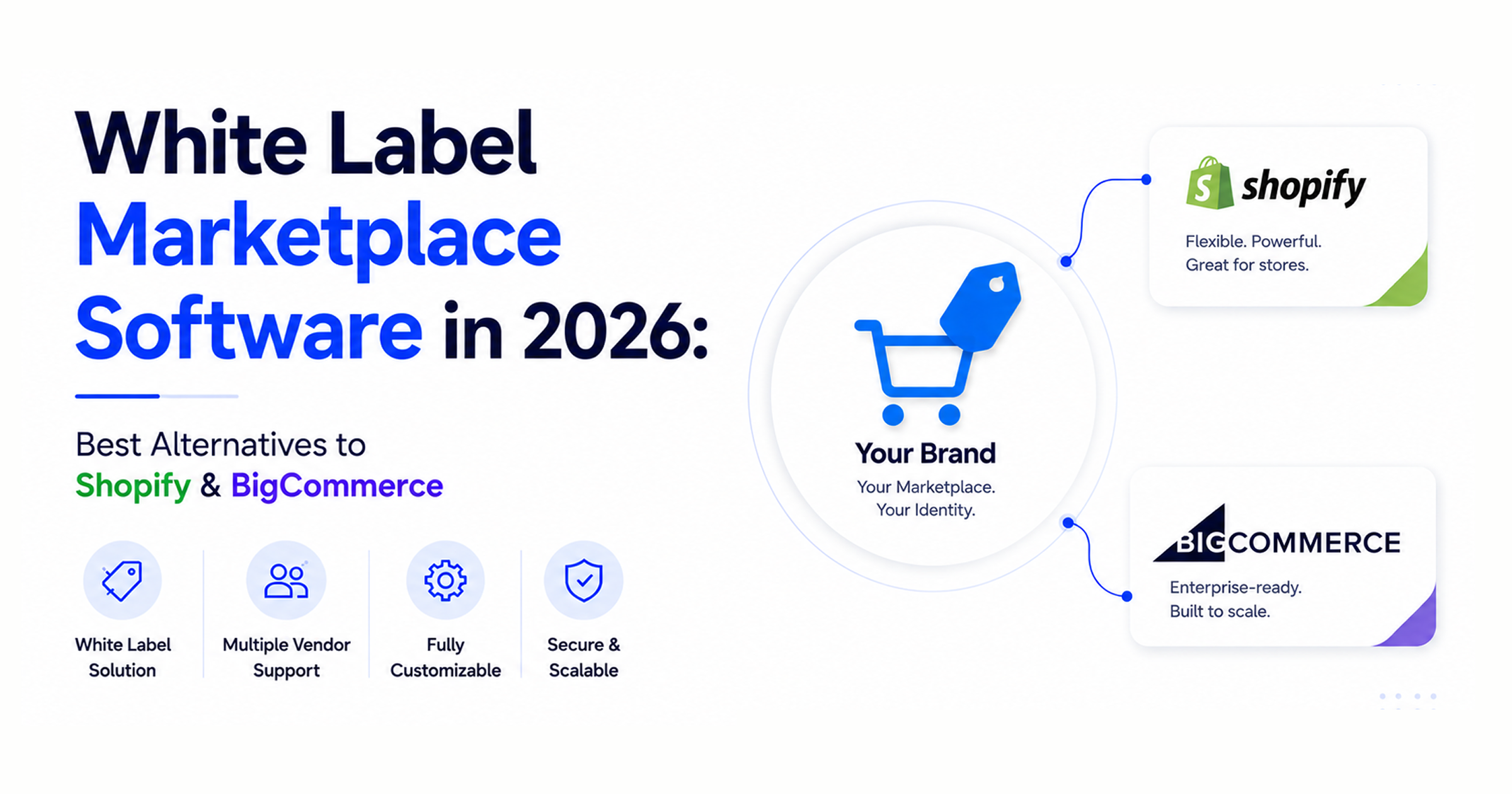
White label marketplace software helps entrepreneurs, enterprises and agencies launch a Multi vendor platform quickly. They do not have to build everything from the start.
If you’d rather build from the ground up, our guide to building a marketplace website from scratch covers that path.
In 2026 more businesses want white label -vendor marketplace solutions. This is because they are outgrowing ecommerce tools. They also want control over their brand. Companies are choosing software for marketplaces that can be rebranded. This software allows for setup handling many vendors and growing over time. It is not like using platforms with plugins, such as Shopify or BigCommerce. For a dedicated B2B-focused build, see our B2B ecommerce development services. This guide will explain how white label marketplaces work. It will also compare solutions, costs and why Webnexs is a top provider of whitelabel marketplace software.
White label marketplace software is the solution, for businesses. They want to launch a multi-vendor platform. White label marketplace software supports deployment.
It also supports vendor scalability and long-term growth. This is why businesses choose whitelabel marketplace software. They want to avoid building everything from scratch. White label marketplace solutions offer branding control. This is what businesses are looking for. They want to outgrow ecommerce tools. White label marketplace software is the answer.
Best White Label Marketplace Software Benefits for Multi Vendor Businesses
White label marketplace software allows businesses to launch fully branded multi-vendor platforms quickly, without building from scratch. A white label multi vendor marketplace provides ownership of code, brand control, faster time to market, and lower long-term costs compared to plugin-based ecommerce platforms.
Key Benefits of White Label Multi Vendor Marketplace Solutions
- 100% brand ownership (logo, domain, UX)
- Faster launch compared to custom builds
- Built-in vendor, admin, and buyer modules
- Lower technical risk and predictable costs
- Enterprise-ready scalability
- Freedom from platform lock-in
Businesses prefer Webnexs because it delivers all these benefits without sacrificing flexibility or performance.
Best White-Label Marketplace Software Use Cases Across Industries
White label marketplace software is used across B2B, B2C, and niche industries to launch scalable, rebrandable platforms. A white label multi vendor marketplace supports diverse business models without custom development overhead.
Common Use Cases
- B2B wholesale marketplaces
- Service marketplaces (consultants, freelancers)
- Vertical ecommerce platforms (fashion, electronics)
- Local delivery and hyperlocal marketplaces
- Enterprise procurement portals
Webnexs supports all these use cases with a modular architecture.
Best White Label Marketplace Software Step-by-Step Launch Process
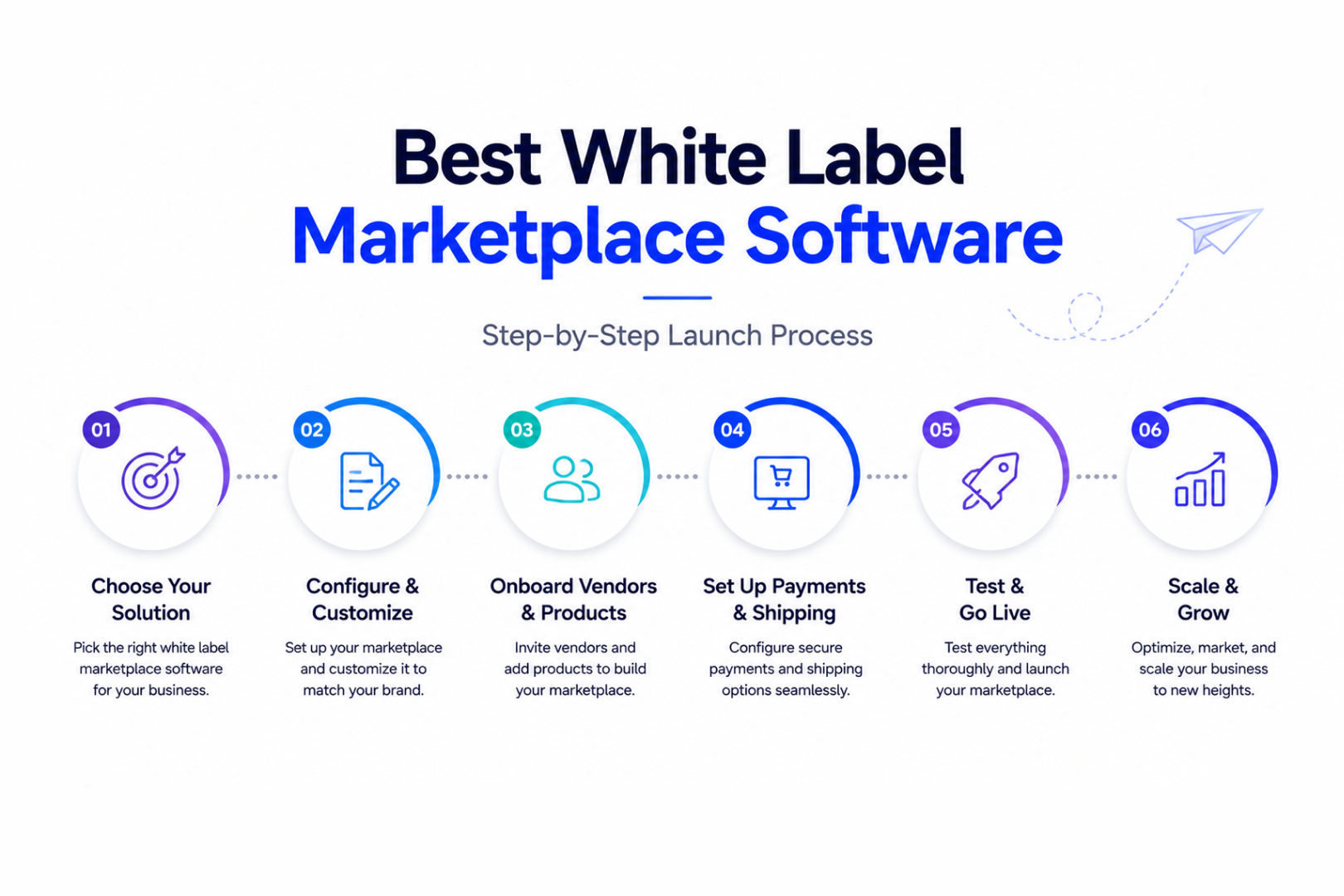
When you start a white label marketplace you need to pick a platform that is already made add your branding to it make rules for the vendors set up a way for people to pay and get sellers to join. Using a white label multi vendor marketplace lets businesses get started in a few weeks instead of a few months and they still get to have a lot of control, over everything just like a big company would have with a white label marketplace.
Step-by-Step Launch Process
- Choose white label marketplace architecture
- Apply branding (logo, UI, domain)
- Configure vendor onboarding and commissions
- Set payment gateways and tax rules
- Customize marketplace workflows
- Test security and scalability
- Launch and scale
Webnexs enables this process in as little as 30 days.
Build a Scalable Marketplace with Webnexs
Best White Label Marketplace Software Cost Breakdown in 2026
The cost of white label marketplace software depends on features, customization, hosting, and integrations. A white label multi vendor marketplace significantly reduces development and maintenance costs compared to custom-built platforms.
Cost Components Explained
| Cost Area | Description |
| Platform License | One-time or annual |
| Branding & UI | White label customization |
| Integrations | Payments, logistics, ERP |
| Hosting | Cloud or dedicated servers |
| Maintenance | Updates and support |
Webnexs offers predictable pricing without GMV-based commissions.
For a deeper understanding of pricing factors, businesses often evaluate multi vendor marketplace development cost before selecting a platform.
Best White Label Marketplace Software Comparison: Top Solutions in 2026
Choosing the best white-label marketplace software requires comparing scalability, branding freedom, customization depth, and long-term costs. Many platforms marketed as “marketplace-ready” rely heavily on plugins, limiting growth.
White Label Marketplace Comparison Table
| Platform | White Label Ready | Multi Vendor Native | Scalability | Best For |
| Webnexs | Yes | Yes | Enterprise | Growth & Scale |
| Shopify + Apps | Partial | No | Medium | Small Stores |
| BigCommerce | Partial | Limited | Medium | Mid-size |
| Custom Build | Yes | Yes | High | High Risk |
Businesses evaluating top solutions in 2026 often prioritize scalability and true white-label ownership.
Best White Label Marketplace Software vs Custom Build: Pros and Cons
When you use white label marketplace software you can get started fast and it is a lot safer than building something from scratch. Building something from scratch gives you the freedom to do whatever you want. It usually costs a lot of money takes a long time and is hard to maintain. White label multi vendor marketplace software is a choice because it helps you with speed, cost and scalability. You get the benefits of a white label marketplace software. It makes things easier, for you. White-label marketplace software is a way to start a multi vendor marketplace.
Comparison Table
| Factor | White Label Marketplace | Custom Build |
| Time to Market | Weeks | Months |
| Cost | Predictable | High |
| Risk | Low | High |
| Scalability | Proven | Uncertain |
| Maintenance | Included | Ongoing |
Best White Label Marketplace Software. Why Shopify And BigCommerce Are Not The Best
Shopify and BigCommerce are ecommerce platforms. They are not white-label marketplace software. Their marketplace features rely on third-party plugins. This limits how much you can grow, customize and own your marketplace in the run. Shopify and BigCommerce have their limits when it comes to label marketplace software. They can’t fully support a white label marketplace. You should look for software that is designed for white label marketplaces.
Key Limitations
- No true white-label ownership
- Plugin dependency
- Limited vendor workflows
- Scaling challenges
This is why businesses search for Shopify and BigCommerce alternatives in 2026.
Best White Label Marketplace: How Webnexs Stands Out
Webnexs is one of the leading providers of white label marketplace software, offering a fully rebrandable, multi vendor platform with enterprise-grade scalability. Businesses prefer Webnexs because it combines speed, flexibility, and reliability without locking them into restrictive ecosystems.
Why Webnexs Is the Best Choice
- 100% rebrandable marketplace software
- Native multi vendor architecture
- Enterprise-grade performance
- Customizable workflows
- Trusted by global clients
Webnexs balances ready-made speed with long-term scalability.
Build a Scalable Marketplace with Webnexs
Best White Label Marketplace Software Real-World Examples
- B2B Distributor Marketplace: Multiple vendors, bulk pricing
- Niche Vertical Marketplace: Fully branded industry-specific platform
- Service Marketplace: Vendor onboarding with commission logic
- Enterprise Procurement Portal: Secure multi-supplier sourcing
Businesses prefer Webnexs because these models work without heavy customization.
Best White Label Marketplace Expert Tips for 2026
- Avoid plugin-heavy platforms
- Choose true white-label ownership
- Plan for vendor scale early
- Ensure API-first architecture
- Focus on predictable costs
Webnexs aligns with all these best practices.
Best White Label Marketplace Software FAQs
Get White Label Pricing
If you’re planning to launch fast with white label marketplace software or need a white label multi vendor marketplace that scales without limitations, choosing the right partner matters.
Webnexs is one of the leading providers trusted for secure, scalable, and rebrandable marketplace solutions.
👉 Get White Label Pricing
👉 Request a Free Demo
Launch faster. Own your platform. Scale without limits.