Key Takeaways
- A video player’s core job is manifest parsing, buffer management and adaptive bitrate switching, not just drawing a play button.
- Most catalogs ship both HLS and DASH because no single format covers every device.
- Startup time is shaped by manifest size, initial rendition choice and DRM handshake time, and it is one of the strongest predictors of viewer retention.
Webnexs builds the video player inside its online video platform, so the build-versus-buy decision is already made and the ongoing maintenance is not the operator’s problem.
Many engineering teams treat the video player as a commodity component, assuming any library will work identically across devices. This assumption fails in production. The player is the only layer that directly interacts with the user’s hardware and network conditions. It decides when to buffer, which quality level to request, and how to handle packet loss. A poor choice here creates invisible friction that drives users away before they even see the first frame. This post breaks down the mechanical responsibilities of the player and the strategic decisions involved in selecting one for a streaming service.

What A Video Player Actually Does
The video player is the software layer that turns a manifest file into an actual playing stream. On play, it fetches the media presentation description, a file that maps out available quality levels and where each segment lives. That file gets parsed for codec support, encryption scheme, and timing metadata. This step decides whether the device can even handle the content. Fail here and nothing plays, no matter how fast the network is. The player has to check the manifest against what the hardware can do before it moves forward at all.
Buffer management controls how much data sits in memory before anything renders. The player downloads ahead of the current playback point, building a cushion against network jitter. Drain that buffer and the stream stalls. Let it grow unchecked and memory use spikes along with latency. So the player is constantly resizing that buffer based on current network conditions and whatever the device can handle. Get this wrong and you get visible stuttering on one end or memory leaks on mobile on the other.
Adaptive bitrate switching is what lets the player change quality mid-stream without anyone touching anything. It watches download speed and buffer health, then picks the highest resolution it can sustain without breaking playback. Network slows down, it drops a tier. Network recovers, it climbs back up. All of this happens at segment boundaries specifically to avoid a visible glitch mid-frame. The algorithm has to catch congestion early but not overreact to every small fluctuation, since bouncing between quality levels too often is its own kind of bad experience.
The DRM handshake is what secures the content before decryption starts. The player requests a license, hands over device identifiers and content keys, and the server confirms the device is actually authorized to decrypt what it’s about to receive. That’s multiple network round trips plus cryptographic work, all before a single frame plays. Slow license server or missing device certificates, and playback fails outright. This step is a direct tax on startup time, which means engineers have to actively work to shrink the gap it creates.
Between the click and the first frame, all four of these are running at once, not in sequence. Manifest parsing, DRM handshake, and the first segment download all kick off in parallel, because the only goal is getting a frame on screen as fast as possible. Slow down any one piece and the whole startup sequence bottlenecks behind it. The player also has to fail gracefully through this, a missing codec or a rejected license request shouldn’t just crash the session. None of this is visible to the viewer, but it’s exactly what defines how fast the product feels. A slow start costs you trust before the stream has even proven it can play smoothly.

Adaptive Bitrate And The Decisions It Makes For You
Adaptive bitrate streaming works by handing the player a menu of renditions and letting it choose, on the fly, which one to pull down next. The core algorithm is watching two things: buffer health and measured network throughput. Buffer’s full and bandwidth is strong, it climbs a tier. Either one falls apart, it steps down before the buffer actually empties out. None of this works without the underlying structure being a playlist of segments instead of one continuous file. That’s the whole reason ABR is possible at all.
Left on default, this gets it wrong in three predictable ways. First, it panics over brief dips in throughput and starts flipping between two renditions, quality churn, which shows up to the viewer as a visible flicker they can’t explain but definitely notice. Second, the bandwidth sample it’s working from is always a little stale, so by the time it reacts to a real slowdown, several seconds have already passed and the buffer’s already stalling. Third, and this one’s easy to miss, the algorithm has zero awareness of what’s actually on screen. A static talking-head shot gets the same treatment as a fast sports highlight, even though nobody can tell the difference between medium and high quality on a shot that barely moves.
There are four real levers here, not custom engineering, just configuration. Cap the top rendition so a phone never requests a 4K stream it physically can’t render. Set a minimum buffer target so the player stays cautious on unreliable cellular. Preload a low-quality chunk upfront so the first frame doesn’t depend on the network handshake finishing fast. Or just tell the player what kind of network it’s on, flag a session as cellular and let it apply a different ceiling than it would on Wi-Fi.
The failure worth naming plainly is wasted bandwidth. Default ABR chases the highest rendition the network can sustain, full stop, regardless of what the screen can actually display. Someone watching on a 720p phone still ends up pulling a 1080p stream if the network allows it. On a metered plan, that’s the viewer’s data. At scale, that’s your egress bill. ABR is the right idea. Treat it as a black box and it optimizes for “highest bitrate possible” instead of “the bitrate that actually matters here,” and those are not the same target.
HLS And DASH And Why You Often Ship Both
HTTP Live Streaming and Dynamic Adaptive Streaming over HTTP are the two protocols running the show in adaptive bitrate delivery, and they’re not interchangeable. HLS came out of Apple and it’s non-negotiable if you want to reach iOS or macOS. DASH is the open standard, and it’s what most Android devices, smart TVs, and browsers actually expect. The real split between them is how they chop up video. HLS sticks to fixed segments, usually ten or twelve seconds, which makes caching simple but slows down how fast the stream can react to a bad network. DASH lets segment length vary, which means faster adaptation, but that flexibility pushes real complexity into the player, which now has to manage a messier timeline.
If your audience is global, supporting only one of these isn’t really a choice. Ship DASH alone and Apple’s entire ecosystem is closed off to you. Ship HLS alone and you’re fighting compatibility problems on a chunk of modern browsers and non-Apple smart TVs. So the architecture gets decided for you. You package the same source video into two separate sets of segments, which means your origin server is storing and serving two parallel versions of everything in your catalog. Your storage footprint just doubled, and it did that for every single asset.
That cost becomes real the moment you start packaging. You need a transcoder that outputs HLS and DASH at the same time, and that’s not a checkbox, it’s two different manifest formats: M3U8 for HLS, MPD for DASH, each one describing available bitrates and segment locations in its own structure. Maintaining both adds real complexity to the pipeline. The upside is that a break in one format usually doesn’t take down the other. The downside is that when something does go wrong, you’re now debugging through two completely separate sets of files and metadata instead of one.
Storage cost scales in a straight line with how many formats you support. HLS and DASH segments are often carrying identical video content, so you’re paying to store the same data twice, and that’s before counting the extra manifest files and indexing overhead layered on top. For a sizable library, that duplication shows up directly in your storage and egress bill. Weigh that against what you’d lose by supporting only one protocol, because that loss is usually bigger.
The failure mode worth naming here is fragmentation. If your pipeline updates one format but not the other in the same run, you end up with a mismatch, an iOS viewer seeing a different bitrate ladder than an Android viewer watching the same title. That inconsistency turns into confused users and support tickets fast. Avoiding it means strict synchronization: both manifests generated from the same source, deployed together, atomically, with real monitoring watching for drift.
Supporting both formats is a straight trade of reach against complexity. You get maximum device coverage, and you pay for it in packaging overhead, doubled storage, and harder debugging. The player itself needs logic to detect the device and pull the right manifest, which is one more layer to maintain long-term. Build a player from scratch and you’re implementing M3U8 and MPD parsing both, which is a real engineering line item, not a footnote, and it needs to be budgeted into the timeline from the start.
Build, Buy Or Embed
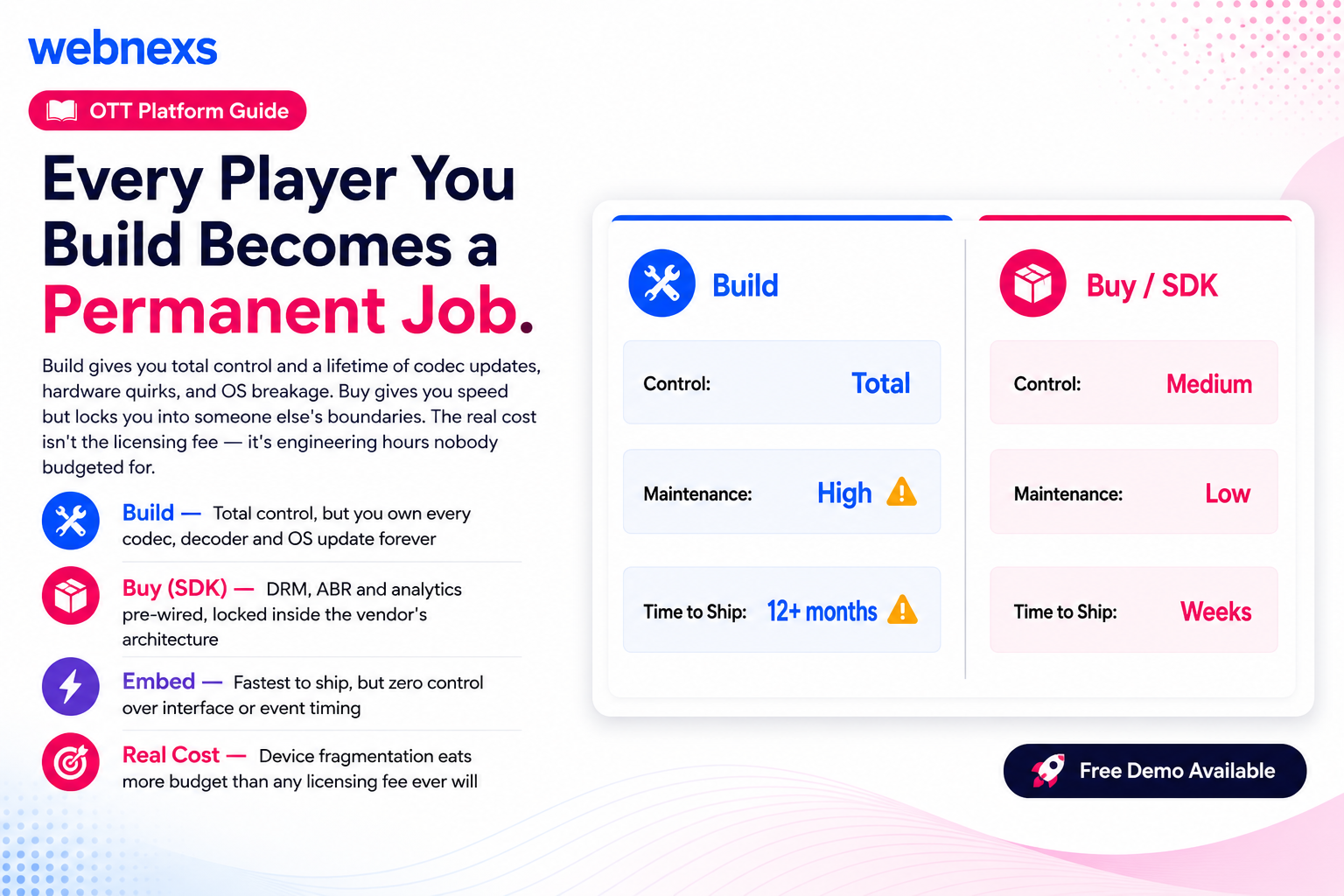
Build a player from scratch and you’re signing up to write the demuxer, the decoder interface, the rendering pipeline, all of it. You get total control over every frame, but that control comes bundled with a permanent job: supporting every codec, every hardware acceleration quirk, every OS update that breaks something you didn’t touch. This path needs a real team of systems engineers who actually understand memory management and low-level graphics APIs, and it’s a multi-year commitment before the thing feels stable across devices. If video isn’t your actual product, this is the wrong call. You’ll spend headcount fixing problems other people already solved years ago.
Buying an SDK is the middle path. You’re getting a pre-built engine, DRM already wired in, analytics hooks, ABR logic, all without touching the core media stack yourself. What you give up is customization. You’re working inside the vendor’s architecture, and if you need to go deep into the rendering pipeline, that door is usually closed. You’ll pay licensing fees and you’ll need someone managing that vendor relationship long-term. Skip this route if you need proprietary rendering effects or your playback logic doesn’t match standard streaming patterns, because you’ll spend more time fighting the SDK’s boundaries than building anything.
Embedding a third-party player, a script tag, a web component, is the fastest way to ship something that works. Drop in a snippet, configure a JSON object, done. The provider handles codec updates and browser changes so you don’t have to think about them. But you lose control of the interface, and you lose control of event timing too. Debugging turns painful fast because you’re operating in an opaque context, and performance problems can hide from your own monitoring entirely. Wrong move if latency actually matters, or if playback needs to sync tightly with complex app state, because that abstraction layer introduces delay you can’t predict or control.
Here’s the actual question to ask: where does your product’s real value live. If it’s a news site or an education platform, the content is the product, and the player is just a utility doing its job in the background. Embed it or buy it, either works fine. But if the value is in the interaction itself, live shopping, a collaborative whiteboard, something where playback has to respond to real-time state, you need the control that only building or deep SDK customization gives you. Get this call wrong and you either burn engineering effort recreating a commodity, or you ship something brittle that can’t flex when users need it to.
Think about maintenance too, because this decision doesn’t end at launch. A custom player needs constant babysitting through browser updates and new devices. An SDK shifts that weight onto the vendor, but now you’re tracking their release schedule and testing every regression they introduce. An embedded player asks the least of you day to day, but you’re fully dependent on the provider’s support and whatever direction their roadmap takes. Each path fails differently: custom players collapse under their own technical debt, SDKs trap you in vendor lock-in, embedded players leave you with no real control when you need it. Pick the one that actually fits your team’s size and how much risk your product can absorb.
The Player API Surface You Will Actually Use
The player API is the contract between your application and the media engine underneath it. You’re never touching the decoder directly. What you’re actually doing is constantly reading and nudging playback state through this surface, current time, duration, buffer levels, and reacting to events it fires when something changes, idle to playing, an error firing mid-stream. Get sloppy with these events and you end up with a play button still showing while the video’s already three seconds in. Small bug, but it’s the kind that makes a product feel broken even when it isn’t.
Quality selection lives on this same surface. ABR handles most of the switching on its own, sure, but you’ll still need a manual override exposed somewhere, a menu listing available resolutions, a way to force a specific bitrate. Useful for testing, useful for a viewer trying to save data on a capped plan. But force a high bitrate onto a weak connection and you’ve just guaranteed buffering, so the API needs to be honest about which qualities are actually viable right now, based on both the manifest and current network conditions, not just what’s theoretically in the ladder.
Analytics and DRM both lean on this exact same surface, just for different reasons. Analytics needs precise timestamps and clean state transitions, the exact moment someone hit play, paused, stopped. Those events come out of the player core, and your application layer has to actually catch them. Miss the granularity here and your analytics data has holes in it, permanently. DRM is a separate demand on the same interface. The API abstracts away license acquisition and key management, but you still have to confirm the player actually supports whatever DRM scheme your content provider requires. The abstraction hides complexity, not compatibility.
How much work this surface takes depends entirely on whether you’re building or buying. Build your own player and you own the whole API design, full control, but also full responsibility for every network interruption and codec error the world throws at you, and you’re the one keeping the interface stable over time. Buy a commercial player and the API is already fixed. You’re adapting your app to fit their shape instead of the other way around. Faster to ship, but you’ve traded away the ability to bend it to your needs.
Get the API surface wrong and you get bugs that are miserable to trace. Say the API can’t tell the difference between a brief network hiccup and an actual permanent failure. Now your app throws a hard error message in a situation that just needed a few seconds to recover on its own. That’s not a crash, it’s worse, it’s a false alarm that trains users to distrust the player and generates support tickets for nothing. The real failure here is a gap between what the player actually knows internally and what your application thinks it knows. Test this under real degraded network conditions before shipping. That gap only shows up under stress, never in a clean demo.
Device Fragmentation Is The Real Cost
On paper a video player is a single piece of software. In practice the same code branch lands on a smart television, a phone and a laptop browser and each of those landings is a separate problem. Smart TVs ship forked WebKit or Chromium builds that lag the desktop by years and their hardware decoders refuse certain codec and audio combinations that a laptop plays without complaint. Mobile adds another axis. Power states, thermal throttling and aggressive background suspension mean a player that decodes cleanly on a spec sheet can drop frames after the device warms up in a pocket. Browsers look uniform but their MSE implementations diverge in subtle ways around buffer windows and timed metadata, which surfaces only on flaky networks.
This is the cost that does not show up in a feature comparison. The player that wins the bake off is rarely the one with the longest feature list. It is the one whose team can show you a matrix of real devices, real firmwares, and reproducible test cases, including the awkward ones like a mid-roll ad on a five year old television, a chromecast hand off, and an iOS background audio recovery. That matrix is the actual product. If the vendor cannot produce one, you will end up building it yourself at a cost that does not appear in any line item.
Honest testing means more than a smoke pass on the latest iPhone. It means a lab with a handful of representative televisions, a way to simulate cellular loss and recovery, and the discipline to record what the player actually did rather than what the API claimed. Screen recordings, decoded frame counts, and network traces are cheap to capture and expensive to skip. A bug found on a device your team owns costs an afternoon. The same bug found by a paying viewer costs a refund and a support ticket.
The failure mode here is silent degradation. The player keeps playing, the dashboard looks healthy and the user notices only that the picture is soft or the audio drops. By the time a churn signal surfaces, the root cause is buried in a firmware string nobody thought to log. The teams that avoid this treat device coverage as a first class requirement rather than a launch checklist item and they refuse to ship a build that has not been observed, not merely compiled, on every tier of device they claim to support.
Startup Time And Why It Decides Retention
Time to first frame is the metric that kills retention without anyone noticing it’s happening. It’s the gap between someone tapping play and an actual pixel showing up, and that gap is quietly stacking up network latency, DNS resolution, the TCP handshake, and however long it takes to pull enough data to start decoding. Stretch that window too far and people don’t wait around wondering. They assume the app is broken and leave before the content ever loads. How the player is architected determines how efficiently it moves through all of this, which is why it matters more than it looks like it should.
The biggest lever you control is the initial bitrate. Start high and you’re downloading more data before anything can play, which drags out latency. Start low and the first frame arrives fast, but now you risk a visible quality jump the moment the player catches up to what the network can actually sustain. That’s a real trade-off, not a settled decision, speed against a slightly awkward quality transition a few seconds in.
How the player handles manifest parsing and segment fetching matters just as much. A good implementation prefetches segments in parallel or leans on HTTP/2 multiplexing to cut down round trips, and prioritizes grabbing that first keyframe and its metadata before anything else. None of this shows up visibly in the UI, but it’s where a lot of the waiting quietly disappears. The catch is that aggressive prefetching burns bandwidth some users didn’t agree to spend, especially on metered connections, so speed and cost end up pulling in opposite directions.
Device decoding capability is another piece people underestimate. Pick a codec the hardware can’t decode natively and the player falls back to software decoding, which is slower and drains more battery. That fallback adds real, noticeable delay right at startup. The player needs to figure out what the device can actually handle fast, and pick codec and resolution accordingly. Skip that step and you get a bad first impression no matter how good the network connection is.
The mistake teams keep making is chasing maximum initial quality instead of speed. Wait for a high-res segment to fully load and the viewer is staring at a black screen the whole time, and that black screen is exactly what drives people to close the app. The better approach is starting modest, something that loads fast, and climbing upward as more bandwidth data comes in. Getting something on screen immediately matters more than that first frame being razor sharp.
At the end of the day startup time is a balancing act between what the network can deliver and what a viewer will actually tolerate waiting for. It also depends on context. Live content needs speed above everything else, no excuses. On-demand content can tolerate a slightly longer start if it buys a better initial quality. What matters most is consistency. Make that trade-off the same way every time, and people learn to trust that pressing play actually starts something.
Player Selection Strategies Compared
| Strategy | Control Level | Maintenance Burden | Best For |
|---|---|---|---|
| Custom Build | Total | High | Unique UX requirements |
| Open Source Library | High | Medium | Standard streaming features |
| Commercial SDK | Medium | Low | Enterprise support needs |
| Native HTML5 | Low | Very Low | Simple web playback |
Pick a player by asking which failure you can actually live with, not which one has the best feature list. Startup time your top concern? Then optimized preloading logic matters more than anything else on the spec sheet. Device fragmentation keeping you up at night? Test on the worst hardware in your actual market before you sign anything, not the flagship phone sitting on your desk. A player behaving fine on a desktop browser tells you nothing about how it’ll hold up on a smart TV, those are practically different runtimes wearing the same name.
And look past the documentation. Plan around the API surface you’ll actually touch day to day, not the one that reads impressively in a sales deck. The right call here isn’t the most powerful option. It’s the one that fits what your team can actually maintain against what your delivery network can actually support.
Reference: HTTP Live Streaming Media Capabilities API.
The Video Player Is Your Product covers the full platform this post is one piece of.
For a side-by-side of the platforms themselves, see our comparison of the top online video platforms.
Frequently Asked Questions
What is a video player?
A video player is the software interface that decodes compressed media streams and renders them to a screen. It manages the buffer, handles network interruptions, and synchronizes audio with video. The core trade-off is complexity versus control. If you build one, you own every millisecond of latency and every error state. If you buy one, you inherit their bug fixes but lose deep customization. The wrong choice is ignoring the player as a product surface. It is the only part of your stack users actually touch.
Should I build my own video player or use an existing one?
Use an existing player unless you have a specific, non-standard decoding requirement. Building your own means maintaining codecs, handling hardware acceleration quirks, and managing memory leaks across dozens of device types. That is a multi-year engineering commitment. The cost is vendor lock-in and limited customization. The trade-off is speed to market versus total control. Choose a library if you need standard features quickly. Choose to build only if your product’s core value depends on a unique playback mechanism that no library supports.
What is adaptive bitrate streaming?
Adaptive bitrate streaming dynamically switches between different quality levels of the same video based on current network conditions. The player monitors throughput and buffer health, then requests segments at a lower or higher resolution. This prevents buffering during congestion and maximizes quality when bandwidth is available. The mechanism relies on a manifest file that lists all available renditions. The trade-off is increased complexity in packaging and slightly higher initial load time to fetch the manifest. It is the wrong choice for live events with strict latency requirements where switching causes visible stutter.
What is the difference between HLS and DASH?
HLS and DASH are both adaptive streaming protocols, but they differ in structure and ecosystem. HLS uses Apple’s proprietary format with TS or fMP4 segments and is dominant on iOS and Apple TV. DASH is an open standard using MP4 segments and is preferred for cross-platform consistency. The mechanism involves different manifest formats and segment naming conventions. The trade-off is that HLS is easier to deploy for Apple-centric audiences, while DASH offers better flexibility for global distribution. The wrong choice is assuming one protocol works everywhere without testing specific device compatibility.
Does a video player handle DRM?
A video player does not handle DRM alone; it integrates with a DRM system to decrypt content. The player requests a license from a DRM server, then uses a secure hardware module to decrypt the video stream. This prevents raw video data from being accessed in memory. The mechanism requires the player to support specific DRM schemes like Widevine or FairPlay. The trade-off is added latency during license acquisition and potential compatibility issues across devices. It is the wrong choice to rely solely on the player for security, as the backend DRM server and key management are equally critical to the protection chain.
Why does my video take so long to start?
Slow start times usually stem from large initial buffers or inefficient manifest fetching. The player must download the manifest, request the first segment, and decode it before rendering. If the manifest is large or the first segment is high-resolution, startup delays increase. The mechanism involves network round-trips and codec initialization. The trade-off is between fast startup and stable playback.
Can one player work on smart TVs and mobile?
One player can work on smart TVs and mobile, but only if it supports the specific hardware decoders and OS APIs of each platform. Smart TVs often use proprietary Linux-based systems with limited codec support, while mobile devices rely on hardware acceleration. The mechanism requires abstracting these differences behind a unified API. The trade-off is that a single codebase may struggle with the fragmented TV ecosystem. It is the wrong choice to assume a web-based player will perform well on low-power TV hardware without native optimization.
What should a video player API give me access to?
A video player API should give you access to playback state, error codes, and performance metrics. You need to know when the buffer is empty, which quality level is active, and why playback failed. The mechanism involves exposing internal state through callbacks or events. The trade-off is that too many hooks can complicate your integration layer. The wrong choice is an API that only exposes basic play and pause controls, leaving you blind to network issues or codec failures that degrade user experience.