

Quick Answer
OTT (over-the-top) advertising delivers video ads via internet-connected devices, while CTV (connected TV) advertising specifically targets smart TVs. OTT offers broader reach across devices, whereas CTV focuses on the TV screen experience. Both leverage streaming platforms but differ in device targeting and viewer context.
For a broader introduction to OTT platforms in general, including monetization models, see our complete guide.
The way brands advertise is changing fast. With more people choosing streaming over traditional TV, businesses are shifting toward OTT (Over-the-Top) and CTV (Connected TV) marketing to reach their audience in a smarter, more targeted way.
But when it comes to OTT vs CTV, which one is the better choice? And how can brands make the most of these platforms?
Streaming isn’t just a trend—it’s the future. Ad spending on OTT platforms and CTV is skyrocketing.
OTT platforms will be in almost every U.S. household by 2024, with CTV leading the way. This massive growth means businesses must invest in OTT and CTV to stay competitive. In this article, we’ll break down key stats, the pros and cons, and the best strategies to help brands make the most of OTT platforms and Connected TV advertising.
What is OTT Advertising?
OTT advertising refers to video ads delivered through an internet connection, bypassing traditional cable or satellite TV providers.
It includes any device that streams video content over the internet, such as smart TVs, gaming consoles, and mobile devices.
OTT advertising can be delivered through standalone apps like Hulu, Amazon Prime Video, and Netflix, or through network apps like ABC, NBC, and CBS.
OTT advertising allows marketers to target specific audiences based on demographics, behaviors, and location.
It provides better targeting than traditional TV advertising, where ads are broadcasted to a broad audience.
How OTT Ads Work

Dynamic Placement: Ads are shown at specific time periods depending on the content type pre-roll, mid-roll, or post-roll.
Such placements are selected after analyzing the user interaction and viewing behavior and aim to get the maximum effect of the ad.
Personalized Delivery: The ads are further advanced by allowing advertisers to target individual users according to their likes, behavior, and demography.
For instance, Hulu gives advertisers the option to reach viewers based on their age, interests, location, and also the devices they have used.
Cross-Device Reach: Through OTT ads, brands can directly and effortlessly reach users across all devices and keep them always visible.
It makes no change if the user transitions from a smartphone to a smart TV—the campaign stays steady in the magnitude of its impact.
OTT Growth Insights (2024 vs. 2027)
Globally, the volume of advertising taking place on OTT platforms in 2024 will be significant, encouraged by cord-cutting trends and the upward shift of streaming services.
By 2027, OTT advertising will grow even more as more viewers migrate from traditional TV to streaming platforms, especially with the growing availability of ad-supported streaming options.
Accelerate your growth by tapping into OTT’s future trends!
What is CTV Advertising?

Connected TV advertising is similar to OTT advertising in that it delivers video ads over the internet.
However, it is specific to televisions that are connected to the internet through a streaming device, such as Roku or Apple TV.
CTV ads are usually delivered through apps that are downloaded onto the device, such as YouTube, Hulu, and Netflix.
Connected TV advertising allows advertisers to reach audiences who have cut the cord on traditional cable or satellite TV services.
It provides a more targeted approach to TV advertising than traditional TV, and it is more cost-effective.
How CTV Ads Work
Integrated Viewing: The advertisement can be incorporated into live streams, on-demand content, or even within the smart TVs‘ app interface.
This capability refers to the extent to which advertisements are linked to content episodes and therefore become an essential and natural scope of the latter.
Household-Based Targeting: The scheme conjures up families or groups, using common screen time for a wider spread.
Similarly to web ads, CTV (Connected TV) ads tend to address all members of the household, which suits mass consumer goods most perfectly.
Ad Formats: Full-screen video ads, and programmatic ads occupy the majority of it. Programmatic buys are the means to achieve accurate targeting at scale, as they can be applied to millions of viewers and personalized communication is coming.
Are you ready to reach audiences on every screen? Learn how OTT ads work!
CTV Growth Insights (2024 vs 2027)
In-home video streaming devices will be widely adopted, with a significant increase in U.S. households using CTV (Connected TV). This trend reflects the ongoing shift towards streaming services and smart TVs.
Digital television expenditure by brands will see substantial growth, driven by their shift toward connected devices and specific target audiences.
Read More: https://blog.webnexs.com/8-marketing-tools-to-boost-your-ott-platform/
OTT vs CTV Advertising: What’s The Difference?
The digital advertising scene is drastically filling up with OTT (Over-the-Top) and CTV (Connected TV) as they mark themselves as dominant platforms.
Both formats are redrawing the methods brands use to connect with audiences. Engagement metrics are set to revolutionize significantly.
Key Differences Between OTT and CTV Advertising:
Device Usage:
OTT Advertising: A way of transmitting video content, regardless of the force of the Internet, to every device – smartphones, tablets, laptops, desktops, and home consoles.
CTV Advertising: Some of the video ads cast a spell on TV sets with smart technology, such as Smart TVs, and the Internet of Things concept of new devices like Roku, Fire Stick, or Apple TV.
Audience Reach:
OTT includes a huge population among both mobile and desktop viewers.
CTV only aims at those TV viewers who are part of the “cord-cutting” movement of the traditional cable and satellite TV providers.
User Experience:
Viewers of OTT normally use the service whenever and wherever they like, such as during travel or in between tasks.
The situation is different with CTV as the content is typically of long form and viewers are in a leisure mode engaged in the content watching either on a TV set.
Ad Targeting:
The two platforms are capable of using data-driven information for targeting purposes. However, OTT usually has the edges in that case because it can reach audience at a more granular level and can connect on different devices.
CTV has fewer device types compared to OTT, but it generally engages the audience better when played on large screens.
OTT vs CTV Advertising: A Comparative Analysis
| Factor | OTT Advertising | CTV Advertising |
| Audience Reach | People with various devices at the same time | Families who watch one screen together. |
| Devices | Smartphones, tablets, desktops, smart TVs. | Smart TVs, Roku, Fire TV, gaming consoles. |
| Ad Formats | Pre-roll, mid-roll, interactive, dynamic ads. | Full-screen video, voice-activated ads. |
| Spending Growth (2024-2027) | OTT spending is growing significantly. | CTV spending is also seeing substantial growth. |
| Completion Rates | OTT ads have high completion rates. | CTV ads boast even higher completion rates, especially for unskippable formats. |
Key Benefits of OTT Advertising
Highly Personalized Ads:
OTT platforms provide the flexibility for the most specific targeting segmentations they have seen so far based on the individual preferences of their users.
For example, Hulu uses data from its users such as their age, location, and content interest to create campaigns that are precisely targeted.
Global Reach:
The growth of internet users is a strong indicator that OTT will be one of these infrastructures representing higher accessibility across regions and devices.
Cost-Effective Models:
Pricing techniques Cost Per View (CPV) and Cost Per Impression (CPI) refer to how businesses can control the budget of their money for marketing to ensure that they only spend it on meaningful contacts.
Key Benefits of CTV Advertising
Immersive Viewing Experience:
Larger screens mean that advertisements will increasingly have more profound effects on us. Advertisements on CTV devices leave a stronger brand impression than on mobile devices.
Family-Oriented Targeting:
Shared screens for the family are very good because they permit advertisements to serve them, and it is particularly advantageous for vacation sale products, retail insurance, or groceries to see it as a unit and buy their product.
Unmatched Engagement Rates:
The ad completion rates in CTV are exceptionally high, due to the fact that viewers are skipping ads on technologically advanced TVs.
Challenges of OTT vs CTV Advertising
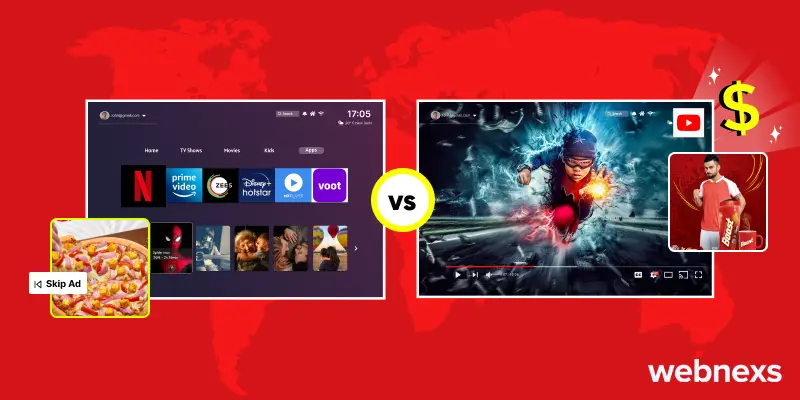
OTT Challenges:
Fragmented Ecosystem:
Digital tools and systems with high capabilities are needed when advertisers distribute their content across several different OTT platforms like Netflix, Disney+, and Amazon Prime Video.
Viewer Resistance:
Many people still oppose ad-supported streaming sites such as OTTs that allow personalization, but they skip the ads every time it is allowable. ad-supported streaming.
CTV Challenges:
High Entry Costs:
Connected TV advertising costs will escalate, making it a more expensive channel that might deter smaller advertisers.
Complex ROI Measurement:
Household-level targeting complicates the process and makes it difficult to pin down CTV campaign effectiveness.
If you’re looking to target smarter, explore the top strategies for OTT and CTV!
Targeting Strategies for OTT vs CTV Advertising
OTT Targeting Strategies:
Behavioral Targeting:
They use blend history and browsing data to offer customized ads according to users. YouTube, for example, utilizes search history to deliver more relevant ads.
Geotargeting:
The vendors consequently will target their products in particular areas or municipalities, which is a local business advantage for getting to your immediate neighbors.
CTV Targeting Strategies:
Household Preferences:
Ads are focused on joint experiences that are shared by the family and are thus designed to be more relevant to the needs of the total family than their only members.
Prime-Time Scheduling:
Prime time ad placements are highest on CTV when advertisers schedule ads during prime time TV hours when households are more likely to watch a program.
Ad Formats for OTT and CTV Advertising
OTT Ad Formats:
Shoppable Ads:
The same permits users to directly purchase the products. To give an example, Amazon Prime Video incorporates clickable product links that have been attached to streams, thus permitting seamless shopping experiences.
Dynamic Ad Insertion (DAI):
Advertisements that are customized are inserted into the live and on-demand content according to the user’s behavior and his/her viewing preferences.
CTV Ad Formats:
Full-Screen Video Ads:
The latent advertisements are meant for full-screen viewing with the aim of gaining experience in this kind of viewing.
Interactive Ads:
Voice-activated commands like “Learn More” or “Shop Now” contribute to a more interactive ad.
Measuring Performance for OTT and CTV Advertising
Measuring performance is crucial for optimizing OTT and Connected TV advertising campaigns.
Advertisers can track metrics such as impressions, viewability, completion rates, and click-through rates.
Additionally, advertisers can use A/B testing to compare the performance of different ad formats and targeting strategies.
Best Practices for OTT and CTV Advertising
To create effective OTT and Connected TV advertising campaigns, marketers should follow some best practices.
First, they should focus on creating engaging, high-quality ads that capture viewers’ attention.
Second, they should develop effective targeting strategies to reach the right audience.
Third, they should use data to measure performance and optimize campaigns for better results.
Read More: https://blog.webnexs.com/top-suggestions-for-ott-broadcasting-in-2021/
Future of OTT vs CTV Advertising
The way digital advertising is evolving will significantly impact the industry.
AI will bring personalization, interactivity, and greater social media distribution, allowing brands to stand out from competitors.
Artificial Intelligence, especially through machine learning, is a key driver in this evolution.
Smart Personalization: AI will deliver hyper-contextualized ads, enhancing engagement with predictive targeting and personalized capabilities.
These ads are more interactive and offer diverse activities for users.
Voice and augmented reality will make ads more real-like, improving user interaction.
Household CTV adoption will grow, particularly in developing markets, and the integration of IoT will be a game-changer, benefiting advertisers by reaching more customers.
If you’re looking to transform your advertising game, get started with Webnexs today!
Conclusion
In conclusion, OTT and Connected TV advertising are two popular platforms that businesses can use to reach their target audience.
While they share some similarities, they have critical differences that advertisers need to understand to make informed decisions.
By understanding the key differences between OTT and Connected TV advertising, businesses can choose the platform that best suits their advertising needs and use it effectively to reach their target audience.
Frequently Asked Questions
What is the difference between OTT and Connected TV advertising?
OTT advertising refers to the delivery of video content over the internet, bypassing traditional TV services. Connected TV advertising, on the other hand, refers to advertising that is delivered specifically to television sets through an internet-connected device.
What are the targeting capabilities of OTT and Connected TV advertising?
OTT and CTV advertising offer robust targeting capabilities, allowing advertisers to target their ads based on demographics, interests, and location.
What pricing models do OTT and Connected TV advertising typically use?
OTT and Connected TV advertising typically use one of two pricing models: Cost per Thousand Impressions (CPM) or Cost per Completed View (CPCV).
What ad formats are available for OTT and Connected TV advertising?
OTT and CTV advertising offer a variety of ad formats, including pre-roll, mid-roll, and post-roll ads.
What are the best practices for using OTT and Connected TV advertising?
To use OTT and CTV advertising effectively, businesses should understand their target audience and the platforms they are advertising on. Advertisers should also consider the ad format and length they are using and tailor their ads to fit the content they are advertising on.
What is the future of OTT and Connected TV advertising?
The future of OTT and CTV advertising looks promising, with more consumers cutting the cord on traditional TV and turning to streaming services. As these platforms continue to grow, advertisers can expect to see more targeting capabilities and advanced analytics tools to help them reach their audience more effectively.
Webnexs builds white-label OTT and video streaming platforms with native apps for web, mobile and smart TVs.
For background, see how OTT media services work.












4 Responses
This blog looks at OTT vs CTV advertisements, and their differences are well highlighted. I like the way the basics are covered in this article!
It should be continued to be perfect if you are to include a comparison table for OTT and CTV in your article that will show the main differences immediately, thus making your readers understand the contrasts faster.
I thought the content was good, but the advantages of each kind of advertising for particular goods should be clarified with the help of OTT vs CTV so the readers can decide wisely.
Really great information on OTT advertising! I can’t begin to tell you how much I enjoyed the way you’ve described the potential of this technique as direct audience targeting; the content is really informative and nicely done.