Multi-Vendor Marketplace Guide
The global eCommerce industry is expanding rapidly, and the multi vendor marketplace model has become a popular way for businesses to connect multiple sellers with customers on a single platform. This guide explains how a multi- vendor marketplace platform works, its key features, benefits, challenges, and real-world examples.
What Is a Multi-Vendor Marketplace?
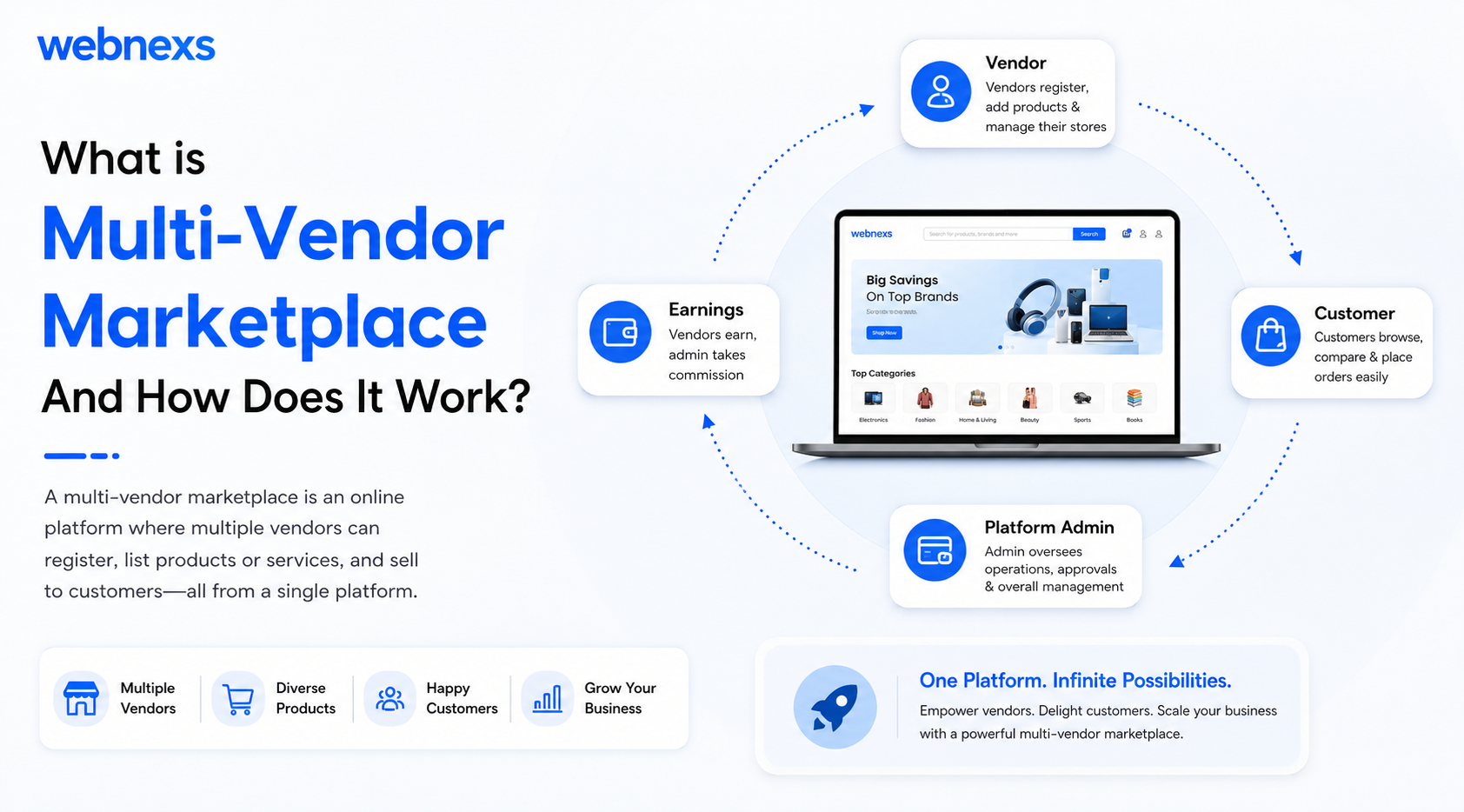
A multi-vendor marketplace is an online platform where multiple independent sellers can register, list products or services, and sell directly to customers. Hence, its a Multi Seller Marketplace.
Examples: Amazon, Ebay, Etsy, Flipkart etc…
Key Participants in a Marketplace:
| Participant | Role |
| Marketplace Owner | Manages the platform and earns revenue |
| Vendors/Sellers | List and sell products or services |
| Customers | Browse and purchase products |
| Payment Gateway | Processes transactions |
| Logistics Partners | Handle shipping and delivery |
How Does a Multi-Vendor Marketplace Work?
A multi-vendor marketplace is an online platform where different sellers sell their products or services to customers. The platform brings buyers and sellers together, while each seller manages their own products and orders.
The process on how multi-vendor marketplace work:
1. Vendor Registration:
- Sellers create accounts and submit business information for approval.
- The platform may verify identity documents, tax details, and business credentials before granting access.
2. Product Listing:
- Approved vendors upload products with descriptions, pricing, images, and inventory details.
- Each seller manages their own catalog through a vendor dashboard.
3. Customer Browsing and Purchase:
- Customers search for products, compare options, and place orders through the marketplace website.
- The platform provides a unified shopping experience regardless of the number of sellers.
4. Payment Processing:
- The customer pays through the marketplace.
- Funds are distributed according to predefined commission structures and payment schedules
5. Order Fulfillment:
- Vendors ship products directly to customers or use integrated fulfillment services.
- Tracking information is updated within the platform.
6. Reviews and Ratings:
- Customers leave reviews after purchase.
- These reviews help build trust and improve vendor accountability.
Here’s a guide on “How to Build a Successful Marketplace App With Multi-Vendor Ecommerce Development”
Multi-Vendor Marketplace vs Single-Vendor Store
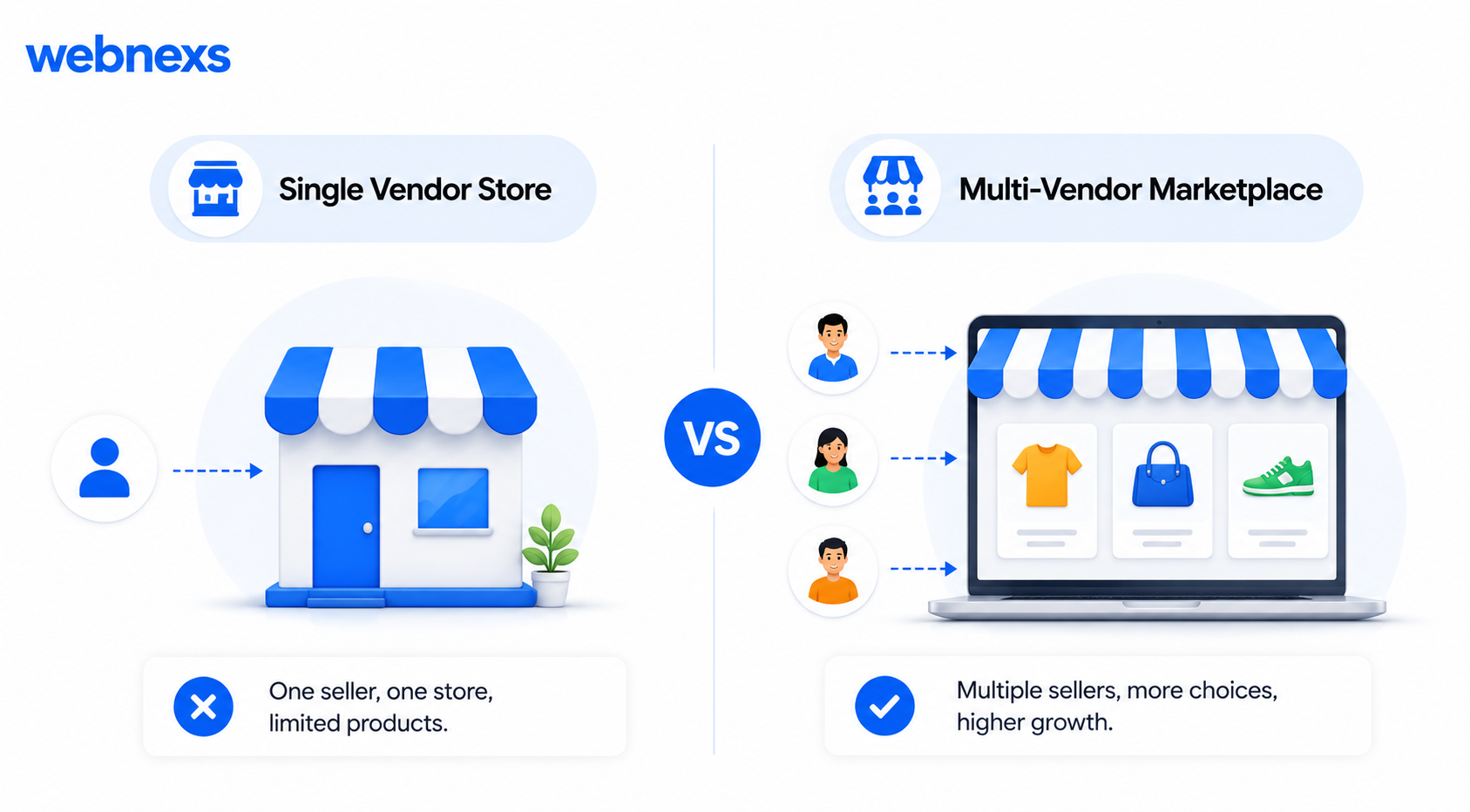
Understanding the difference between these two models helps businesses choose the right approach. The comparison between Multi-vendor marketplace vs Single vendor store
| Feature | Multi- Vendor Marketplace | Single-Vendor Marketplace |
| Sellers | Multiple | One |
| Product variety | High | Limited |
| Stock Ownership | Vendors | Store owners |
| Scalability | High | Moderate |
| Revenue Sources | Commissions, subscriptions | Product sales |
| Vendor Management | Required | Not required |
Benefits of a Multi-Vendor Marketplace
- Wider Product Selection
Multiple sellers contribute products, increasing catalog diversity and customer choice.
According to Amazon, more than 60% of products sold on Amazon come from independent third-party sellers, highlighting how multi-vendor marketplaces can offer significantly broader product variety than single-seller stores.
- Faster Business Growth
Marketplace owners can expand product offerings without purchasing inventory. Global online marketplace sales account for approximately two-thirds of worldwide eCommerce sales.
Research by Digital Commerce 360 indicates that marketplace business models often scale faster because platform owners can add new products through vendors rather than investing in inventory.
- Lower Operational Risk
Inventory management responsibilities remain with vendors. Businesses avoid expenses associated with overstocking, dead stock, and warehouse management, making the model more capital-efficient.
🚀 Marketplace owners can scale product catalogs without investing in inventory.
- Multiple Revenue Streams
Revenue can be generated through:
- Commission fees
- Subscription plans
- Featured listings
- Advertising
- Transaction fees
💰 Revenue can come from commissions, subscriptions, ads, featured listings, and transaction fees.
Essential Features of a Multi-Vendor Marketplace
Vendor Dashboard
Allows sellers to manage:
- Products
- Orders
- Inventory
- Payments
Customer Dashboard
Customers can:
- Track orders
- Save wishlists
- Manage profiles
- View purchase history
Advanced Search and Filters
- Helps customers quickly find products using filters such as category, price, brand, and ratings.
- Improves user experience by reducing search time and making product discovery easier.
Secure Payment Integration
- Supports multiple payment methods, including cards, UPI, net banking, and digital wallets.
- Ensures safe and secure transactions through encryption and fraud protection measures.
Review and Rating System
- Allows customers to share feedback and rate products or vendors based on their experience.
- Builds trust and helps buyers make informed purchasing decisions.
Analytics and Reporting
- Provides detailed insights into sales performance, customer behavior, and market trends.
- Helps marketplace owners and vendors make data-driven decisions to improve growth and profitability.
Challenges of Running a Marketplace
While marketplaces offer significant opportunities, they also present challenges.
- Vendor Quality Control
Maintaining product quality across multiple sellers can be difficult.
- Customer Support Complexity
Issues may involve multiple vendors, requiring coordinated support processes.
- Commission Management
Accurate commission calculation and payment distribution are critical.
- Competition
Marketplaces must attract both vendors and customers to achieve growth.
Revenue Models for a Multi-Vendor Marketplace
- Commission-Based Model
The marketplace earns a percentage from every transaction.
- Subscription Model
Vendors pay monthly or annual fees for access.
- Listing Fees
Sellers pay to publish products.
- Advertising Revenue
Businesses pay for promoted listings and sponsored placements.
Real-World Examples of Multi-Vendor Marketplaces
- Amazon
Amazon allows millions of third-party sellers to list and sell products globally.
- Etsy
Etsy focuses on handmade, vintage, and creative products.
- eBay
eBay enables individuals and businesses to sell products through auctions and fixed-price listings.
Best Practices for Marketplace Success
- Simplify vendor onboarding.
- Implement strong verification processes.
- Offer multiple payment options.
- Monitor seller performance.
- Invest in customer support.
- Optimize mobile experiences.
- Use analytics to improve operations.
Conclusion
A multi-vendor marketplace enables multiple sellers to offer products or services through a single platform while the marketplace owner manages the technology and customer experience. This model provides scalability, diverse revenue opportunities, and access to a broader product catalog without the burden of inventory ownership.
Why Choose Webnexs for Multi -Vendor Marketplace Development?
Webnexs helps businesses launch feature-rich marketplace platforms with advanced functionalities and scalable architecture.
Our solutions offer:
- Custom marketplace development
- Vendor management tools
- Secure payment integrations
- Mobile-ready platforms
- Multi-currency support
- Enterprise-grade security
- Ongoing technical support
Explore our Multi-Vendor Marketplace Solution and 10 Best Multi-Vendor Marketplace Platforms for eCommerce in 2026 to learn more.
Ready to Launch Your Marketplace?
Looking to build a scalable online marketplace platform?
Book a demo with our team today and discover how our marketplace development solutions can help you launch faster, manage vendors efficiently, and grow your business.
Contact us for more information
What is a multi vendor marketplace?
A multi vendor marketplace is an online platform where multiple sellers can list and sell products or services to customers through a single website.
How does a multi vendor marketplace make money?
Marketplaces typically earn revenue through commissions, subscriptions, listing fees, transaction fees, and advertising.
What are examples of multi vendor marketplaces?
Popular examples include Amazon, Etsy, eBay, Alibaba, and Fiverr.
What features should a marketplace have?
Key features include vendor management, product catalogs, payment processing, reviews, order tracking, analytics, and customer support tools.
Is a multi vendor marketplace profitable?
Yes. A well-managed marketplace can generate recurring revenue while scaling without significant inventory investments.
What is the difference between a marketplace and an eCommerce store?
A marketplace allows multiple vendors to sell through one platform, while an eCommerce store typically sells products from a single business