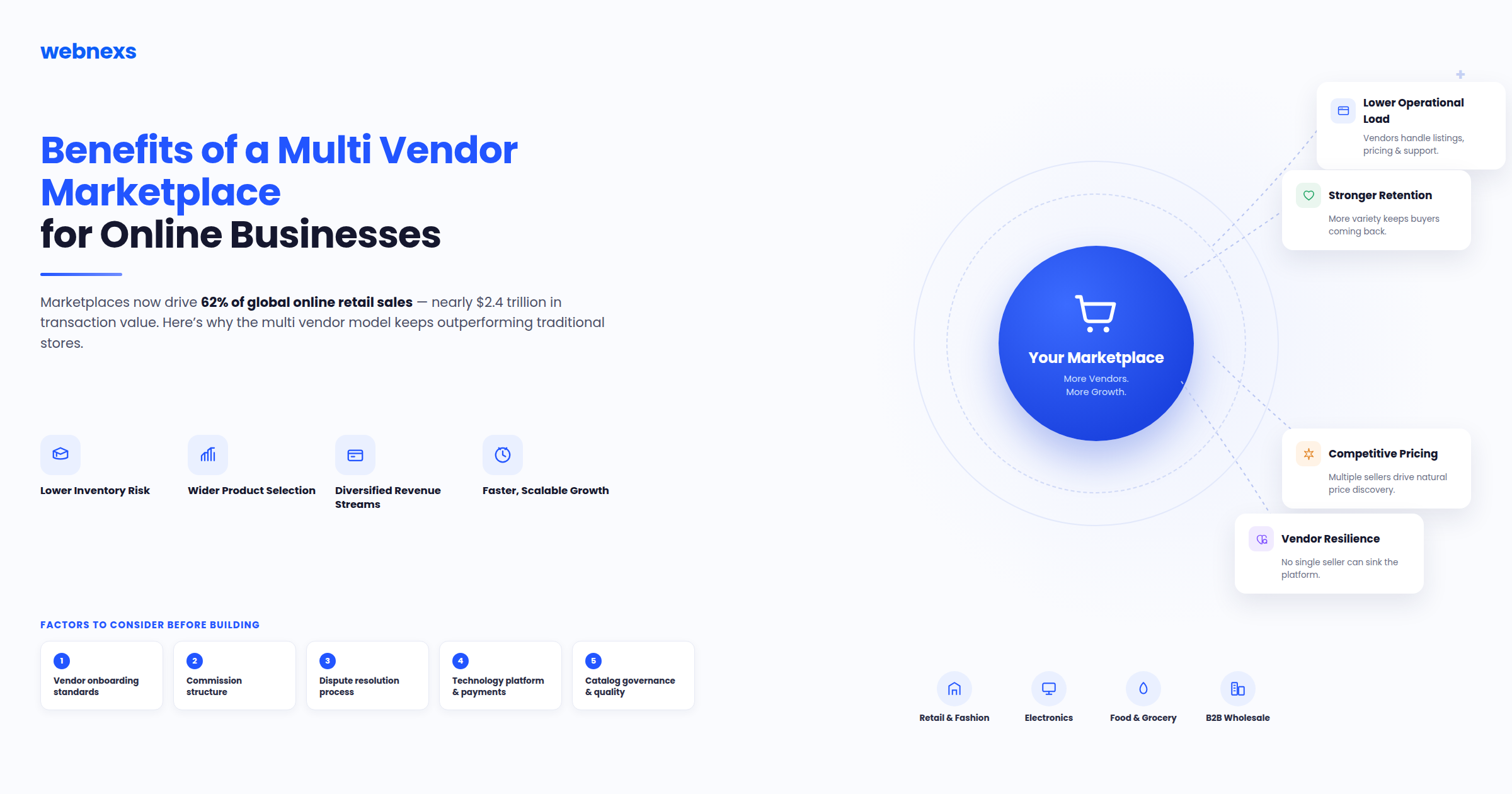
Benefits of a multi vendor marketplace are reshaping how online businesses think about growth, risk, and revenue in 2026.
Online marketplaces aren’t just a trend anymore. They’re quietly running the show. Roughly 62% of global retail e-commerce now flows through them, adding up to nearly $2.4 trillion in transactions. That kind of shift doesn’t happen by accident. It comes down to a real structural edge that the multi vendor marketplace model has, one that traditional single-seller stores simply can’t replicate on their own.
So if you’ve been wondering whether it’s time to turn your online business into a marketplace, you’re in the right place. This guide walks through exactly why so many businesses are making that leap, backed by real numbers and a case study you can actually verify.
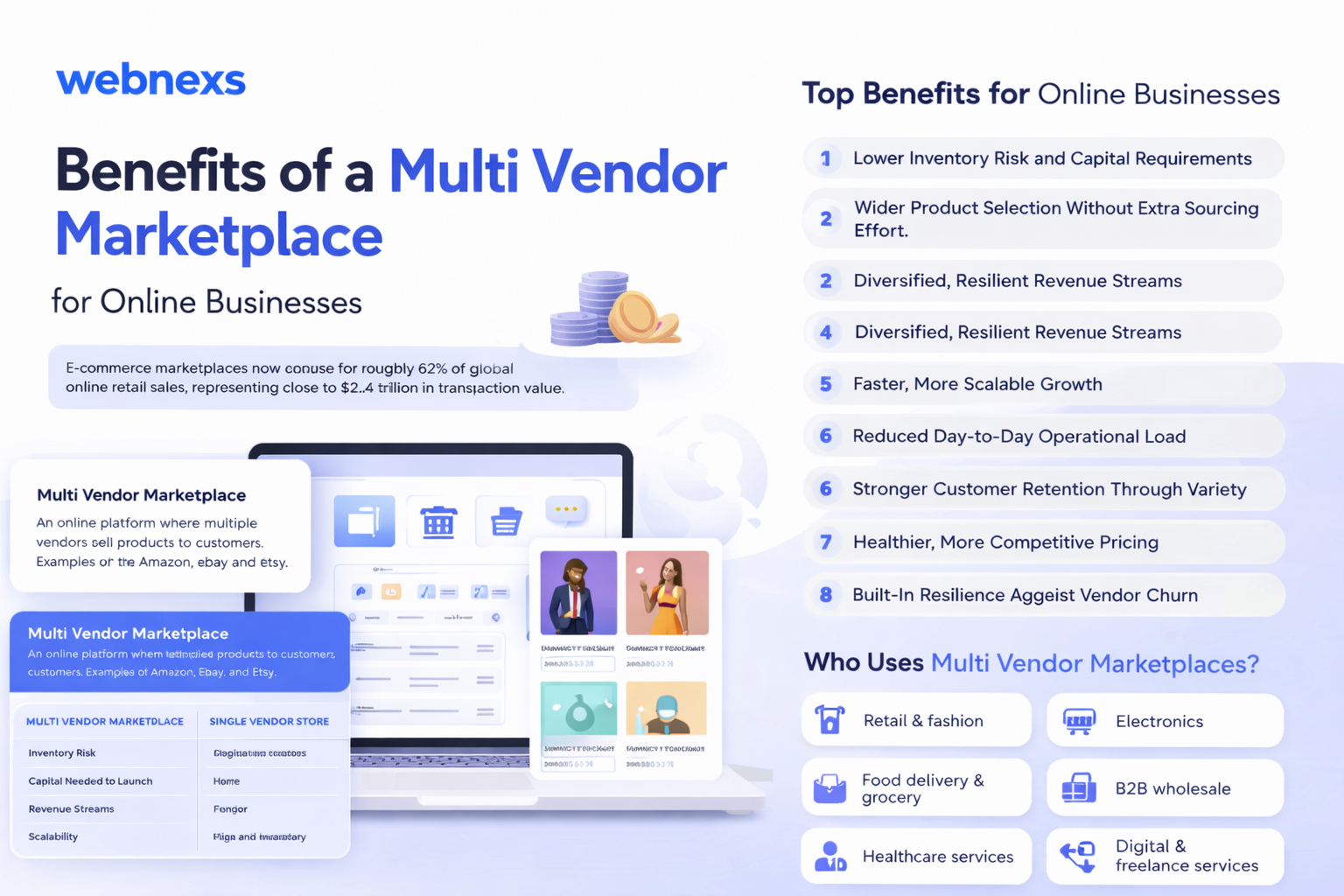
Multi Vendor Marketplace
A multi vendor marketplace, in plain terms, is an online platform where multiple sellers sell their own products or services to customers, all through one shared website. Amazon, eBay, Etsy, these are the names everyone already knows.
What Makes a Multi Vendor Marketplace Different?
Several independent sellers, one platform. The platform owner handles payments, customer experience, vendor relationships. But here’s the real difference: unlike a single-vendor store, the platform doesn’t actually own the inventory. That’s on the vendors. Always has been.
This one structural difference is what unlocks pretty much every benefit listed below. It’s also exactly why Amazon, Etsy, and Carrefour have all pushed hard into this model in recent years, not as an experiment, but as a real shift in how they operate.
Top Benefits of a Multi Vendor Marketplace for Online Businesses
1. Lower Inventory Risk and Capital Requirements
Traditional retail ties up cash in inventory that might never sell. A multi-vendor ecommerce platform doesn’t work that way. Vendors carry their own stock. They bear that risk, not you.
Which means the upfront capital needed to launch or scale drops dramatically. You’re not out there buying goods speculatively and hoping they move.
2. Wider Product Selection Without Extra Sourcing Effort
Every vendor who joins brings their own catalog along with them. Your product range just grows, automatically, as the vendor base grows. No extra sourcing work needed on your end, none at all.
A broader catalog means customers find what they’re after more often. That drives conversion. That drives repeat visits too.
3. Diversified, Resilient Revenue Streams
Single-seller stores lean on one income source: product margin, full stop. A multi vendor marketplace revenue model looks nothing like that. You’ve got:
- Commission on every transaction
- Vendor subscription or listing fees
- Featured placement and advertising fees
- Value-added services sold straight to vendors
That mix is what makes marketplace revenue so much more resilient when demand shocks hit any single category.
4. Faster, More Scalable Growth
Scaling inventory-based retail means expanding warehouses, hiring more staff, slow and expensive. Scaling a marketplace? Mostly just onboarding more vendors. Faster. Cheaper. A genuinely different growth strategy.
New sellers often bring their own customers too. That’s compounding growth, not the linear kind.
5. Reduced Day-to-Day Operational Load
Photography. Pricing. Customer support for specific products. All of that increasingly falls on vendors, not you. Your team gets to focus on platform experience, trust, growth, instead of getting buried in SKU-level work.
6. Stronger Customer Retention Through Variety
Customers who find everything they need in one place, electronics, fashion, groceries, whatever, tend to stick around. They don’t go shopping elsewhere. This is one of the real advantages of the online marketplace model. Retention just grows alongside product variety, almost naturally.
7. Healthier, More Competitive Pricing
Multiple vendors selling similar products creates price competition on its own, no extra effort required. Customers benefit. And your platform stays attractive against single-vendor competitors who simply can’t match that kind of pricing flexibility or choice.
8. Built-In Resilience Against Vendor Churn
One vendor underperforms, or leaves entirely? The marketplace isn’t sunk by it, not the way a single-supplier store would be. Other vendors keep generating sales. Platform stability holds. Business risk stays lower.
Multi Vendor Marketplace vs. Single Vendor Store
| FACTOR | MULTI VENDOR MARKET PLACE | SINGLE VENDOR PLACE |
| Inventory risk | Carried by vendors | Carried by the business |
| Capital needed to launch | Lower | Higher |
| Revenue streams | Commissions, fees, ads, subscriptions | Product margin only |
| Scalability | Fast (add vendors) | Slow (add inventory/staff) |
| Resilience to vendor/supplier loss | High | low |
Who uses Multi Vendor Marketplaces?
Some sectors see outsized results from this model:
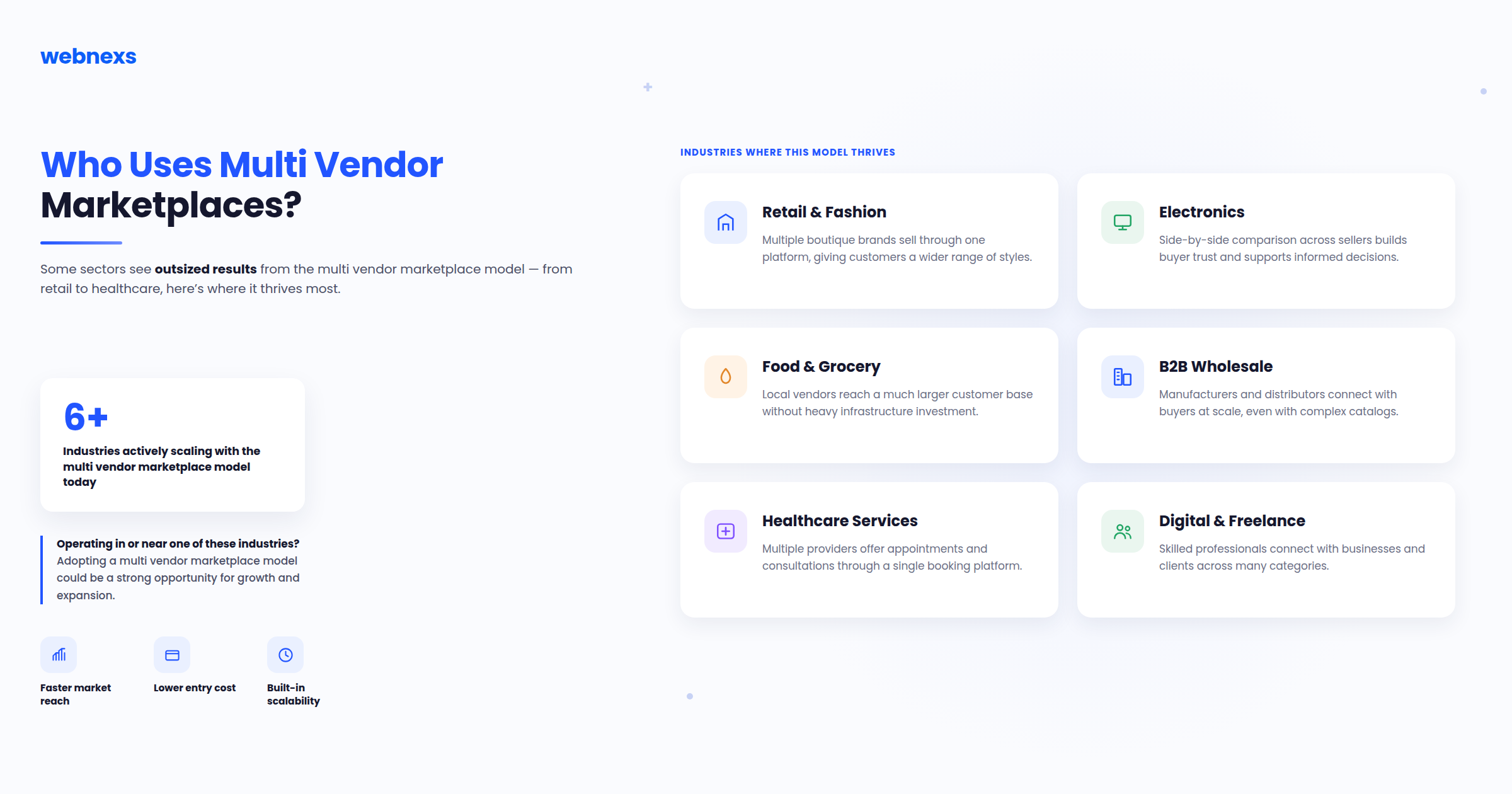
- Retail and fashion. Multiple boutique brands, one platform, customers get a far wider range of styles and products than any single brand could offer alone.
- Electronics. Customers compare products, prices, sellers, all in one place. That builds trust. That supports better purchasing decisions.
- Food delivery and grocery. Local vendors reach a much bigger customer base without sinking money into their own online infrastructure.
- B2B wholesale. Manufacturers, distributors, suppliers, all connecting with business buyers through one centralized marketplace, often juggling large, complex product catalogs.
- Healthcare services. Multiple providers offering appointments, consultations, specialized services, through a single platform instead of a dozen separate ones.
- Digital and freelance services. Businesses and individuals connecting with skilled professionals across all kinds of categories, opportunity flowing both ways.
If your business sits in or near any of these industries, adopting a multi vendor marketplace model could genuinely be a strong opportunity for growth and expansion.
Factors to Consider Before Building a Multi Vendor Marketplace
This isn’t just a technology decision. It’s a business decision too. An operational one. Before getting started, a few things are worth thinking through carefully.
- Vendor onboarding standards. How exactly will you vet sellers for quality and reliability?
- Commission structure. What rate keeps vendors motivated while still protecting your margins?
- Dispute resolution process. How will returns, complaints, conflicts between buyers and vendors actually get handled, fairly, consistently?
- Technology platform. Does it support split payments, vendor dashboards, multi-seller order routing right out of the box? Or are you looking at custom development?
- Catalog governance. How will you stop duplicate, low-quality, or inconsistent listings from piling up as your vendor base grows?
Get these right early. They tend to matter more for long-term success than any single feature decision ever will.
Multi Vendor Marketplace Platform Options
The technology approach you pick affects cost, timeline, how easily things scale down the road. Most businesses end up choosing between three paths.
Ready-made marketplace software. Fastest launch, vendor dashboards and payment splitting already built in.
Plugin-based solutions, multi-vendor extensions for WooCommerce or Shopify. Ideal if you’re adding marketplace features to an existing store without spending a fortune.
Or fully custom-built platforms. Complete control, built for complex vendor requirements, but it’ll cost you more time and more budget.
The right choice really comes down to three things: how fast you need to launch, how specialized your requirements actually are, and what budget you’ve got to work with.
Conclusion
The benefits of a multi vendor marketplace for online businesses go way beyond just hosting more sellers. It’s a fundamentally more resilient, more scalable way to grow, and Carrefour Brazil’s GMV growth is real-world proof of that. Lower risk. Diversified revenue. Faster scalability. This model is one of the strongest paths forward in modern e-commerce, full stop.
As customer expectations for choice, convenience, and competitive pricing keep climbing, the marketplace model keeps looking more and more attractive for businesses willing to make the shift. Get the strategy right, get the technology right, and a multi vendor marketplace can build lasting value while supporting real, sustainable, long-term growth.
What is a multi vendor marketplace?
A Multi Vendor Marketplace is an ecommerce platform where multiple independent sellers can list and sell products or services through a single website. The marketplace owner manages the platform, customer experience, and transactions, while vendors handle their own inventory and product listings.
How does a multi vendor marketplace make money?
Most multi vendor marketplaces generate revenue through commissions on sales, vendor subscription fees, listing charges, featured product placements, and advertising opportunities. Many successful marketplaces use a combination of these revenue streams to maximize profitability.
What are the main benefits of a multi vendor marketplace?
The key benefits include lower inventory risk, wider product selection, diversified revenue streams, faster scalability, reduced operational costs, and improved customer retention. Since vendors manage their own inventory, marketplace owners can focus on platform growth and user experience.
Is a multi vendor marketplace better than a single vendor store?
The answer depends on business goals. A multi vendor marketplace offers greater scalability, product variety, and revenue diversification, while a single vendor store provides more control over inventory, pricing, and brand experience. Businesses looking for rapid expansion often prefer the marketplace model.
Which industries benefit the most from a multi vendor marketplace?
Industries such as retail, fashion, electronics, food delivery, B2B wholesale, healthcare services, and freelance marketplaces commonly benefit from the multi vendor model. These sectors thrive because customers value having multiple sellers and product options in one place.