

In Video on Demand, there are two key revenue models that businesses and content creators need to know about: AVOD & SVOD.
- AVOD gives viewers free access to the content provided, with the business’s revenue coming from displaying ads alongside the videos.
- SVOD needs a subscription fee for users in order for them to watch the content, thus offering a direct profit for the business.
In 2020, the market for AVOD became more competitive and the cost per user dropped as more avenues for revenue generation. Meanwhile, the size of the SVOD market is grow and reach USD 32.3 billion by 2025.
You need to know about these OTT monetization models and choose which is the best for your business.
SVOD Vs AVOD: Which Is Best For Your VOD Business
The internet has completely transformed how we consume video and audio content. Instead of being restricted to traditional TV channels, we now have the freedom to choose what we want to watch and when we want to watch it from a curated list.
This concept falls under the main term of Video on Demand (VOD), and businesses have various revenue models to consider if they decide to pursue this route. The top two models are Advertising Video on Demand (AVOD) and Subscription Video on Demand (SVOD).
In 2020, AVOD experienced significant growth as the market became increasingly competitive, leading to a decrease in monthly costs per user. Businesses sought out more avenues for revenue generation. On the other hand, SVOD advertising remains highly lucrative, with the market projected to reach USD 32.3 billion by 2025.
The ongoing competition between SVOD and AVOD continues to shape the landscape of the VOD industry. With this in mind, let’s delve deeper into the dynamics of SVOD vs. AVOD and determine which monetization model is the optimal choice for your online video streaming venture.
What is SVOD?
SVOD stands for “Subscription Video on Demand”. This leads to customers needing to subscribe and access video streaming services.

Advantages of SVOD:
1. Expected And Recurring Income
Keeping a fixed price per user per month or year enables OTT video platforms to manage a solid and expected amount of income every month. You can calculate the money and use it to give useful content to your viewers.
2. Best Profit Margins
It allows greater revenue with only a few thousand subscribers other than OTT video monetization models.
3. Better Customer Support
This customer base enhances your business growth and earns larger viewers who will be interested in paying to watch your videos.
Related: How do “SVOD” platforms create more income in streaming video content?
The Disadvantage of SVOD:
1. SVOD only operates at scale, Unsafe at a low user authority
SVOD does not essentially link operational values of bandwidth directly to resources, it usually runs on a larger scale. The price of delivery decreases on a scale. High costs or restrictions on content can make a low number of customers.
2. Income-sharing deals are difficult in SVOD
It is hard to decide which movie or serial inspired the customer to purchase the subscription. Video views and commitment data are at the backside, the almost income distribution model becomes critical. It is a mixture of pre-paid permission charges for content, income share on the number of views, and property price, etc.
Related: How to Monetize Your Video Content using SVOD, TVOD, and AVOD
The subscription method can generate a steady stream of income, including:
- Live-events: Customers can watch a short live stream event, usually just one to two hours lasting.
- Direct live-streams: Customers can watch your content, which is telecast continuously 24/7.
- On-demand records: Customers can watch particular video content at any moment without waiting for a special chance to get it.
What Is AVOD?
Advertising-Based Video on Demand, companies earn capital by marketing advertisements on their videos, like display banners, sponsored content, video commercials, etc. They do not price any views of watchers to get their content.
Frequently connected the marketing pattern with traditional TV. These services like Pluto TV and Tubi are seeking to make free TV.
Many services like Netflix, Prime, and Disney+ struggling for customers’ money may have a valid reason.
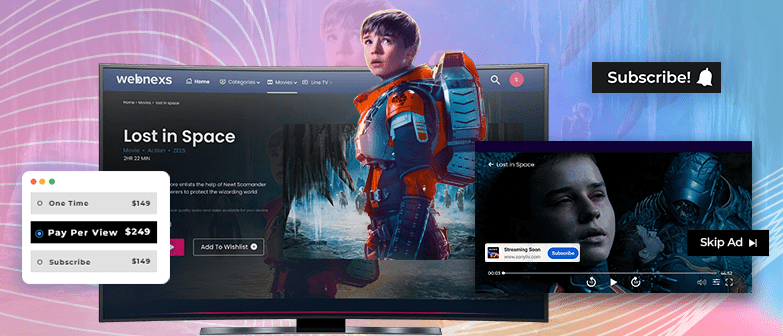
Advantages of AVOD:
1. Unlimited Videos for Free
Customers may watch ads and access some content for free or with a premium, rather than paying for a subscription or viewing ad-free content.
2. Customized Ad suggestions for brands
It enables the platform to join the customers and make the brands satisfied by assisting ads to only important people.
YouTube is the best example.
3. Vast Reach
Video-watching platforms have large and different viewers that businesses can use with targeted advertisements.
4. Popular Viewership
The shortage of a uniform payment assures that all video content can got by anybody everywhere, and this improves the range and demand of your platform rapidly.
The Disadvantage of AVOD:
1. Runs only on a large system.
Video is a high-frequency-rich business. Besides, TVOD or SVOD allows the content partner to overcome the loss of bandwidth in a small system. It also needs a large method to have low per-unit streaming rates.
2. Profitability takes time to hit:
It takes more time to improve profits, because of bandwidth costs, proper improvements of ad variables, and content type
Possibility services:
1. Provide video advertisements from your direct sponsors and supporters. You can select your ad rates by yourself and receive profits directly from the sponsors and supporters.
2. Advertise your ads to different OTT TV apps. You can advertise your ads with the Connected TV Ad Network and get finance lavishly!
3. Merge ad stocks from major video ad networks on your web players, mobile apps, and TV app platforms to get ad income from the networks.
How to choose video Monetization Model: SVOD and AVOD
The choice between the two models should be based on your specific business needs and the following considerations:
- Content-Type
- Advertising perspective
- Customers enumeration
- Content rates and authority
- Financing in platform and content management systems
- Financial target per month and year
The Significance of Picking the Right Income Model
The monetization models must be able to function efficiently in a multi-device, web-based environment that accommodates a high volume of concurrent users.
As a decision, they need to be protected and private and quickly unlock passage for users against payment.
Related: Best VOD Monetization Model in 2021
The Advantages of Choosing Monetization
Here are some benefits which will help you choose the monetization model between Subscription Video on Demand and Advertising Video on Demand:
Regular Income:
Monetization strategies assure constant income streams for functional and preservation costs along with earnings.
Safe Content:
Implementing paywalls or advertisements ensures that the content is secure and protected against theft..
Privacy:
Subscriptions assure privacy for customers, who can personalize their watchlist as per their circumstances.
Manageable Monetization:
OTT suppliers can differ in their monetization strategies based on the type of content, to keep the usual content free and premium content safe.
How VOD Helps Your Business in Generating Revenues?
The demand for video-on-demand services is currently at an all-time high, making it a lucrative industry for businesses to enter. By partnering with the world’s best VOD solution providers, companies can build successful VOD platforms that generate steady revenue streams. Additionally, businesses can learn more about what is VOD and its potential benefits as they explore this rapidly growing market. These platforms often incorporate various monetization models to fund their operations and can be flexible and scalable enough to support thousands of content pieces and millions of users simultaneously.
Frequently Asked Question(FAQ)
1. What is AVOD? Definition And Its Works?
AVOD, or Advertising Video on Demand, refers to a monetization model in which users can access video content for free, supported by targeted advertisements. Platforms generate revenue by displaying ads to viewers, offsetting production costs and facilitating content delivery.
2. AVOD Vs SVOD: Which One Is The Best Revenue Model?
The choice between AVOD and SVOD depends on various factors including the type of content, audience demographics, and financial goals. AVOD offers free access to content with revenue generated from ads, while SVOD involves a subscription fee for unlimited access to a curated content library. Both models have their merits, and the optimal choice depends on the specific needs and objectives of the VOD business.
3. What is SVOD? Definition And Its Works
SVOD, or Subscription Video on Demand, is a monetization model where users pay a recurring subscription fee to access a catalog of audio or video content. Subscribers enjoy unlimited access to content for the duration of their subscription, similar to traditional TV packages but tailored for online video content.
4. Difference Between AVOD Vs SVOD Revenue Model?
The primary difference between AVOD and SVOD revenue models lies in their monetization strategies. AVOD relies on advertising revenue generated from displaying ads to viewers, while SVOD generates revenue from subscription fees paid by users for access to a curated content library. The choice between the two models depends on factors such as content type, audience preferences, and revenue goals.
5. Why Does The VOD Business Model Require SVOD, AVOD?
The VOD business model benefits from incorporating both SVOD and AVOD monetization models to cater to diverse audience preferences and maximize revenue opportunities. SVOD offers a steady stream of recurring revenue from subscribers, while AVOD provides free access to content supported by ads, expanding the platform’s reach and engagement. By offering both models, VOD businesses can appeal to a broader audience and enhance their revenue potential.













14 Responses
This blog offers an excellent analysis of the benefits and definition of each type of AVOD & SVOD platform model. Much appreciated!
Good job. Explaining the monetization model for SVOD vs AVOD.
This article provides an excellent comparison between AVOD Vs SVOD in VOD businesses. I am thankful for the insight it has provided!
I really appreciate you taking the time to share insights about SVOD and AVOD monetization strategies. I’m interested to know more about how VOD can be used for streaming platforms as a revenue model.
An Informative Article on Understanding the Differnce between AVOD and SVOD and Their Delivery Modes: Is Simultaneous Content Streaming and Monetization across Multiple Devices Feasible?
Interesting Blog! Thanks for sharing about SVOD vs AVOD monetization platform. I am also looking to know more about the revenue model VOD for streaming platforms.
I really appreciate your writing about SVOD vs AVOD monetization platforms. I would love to hear more about the revenue model VOD for streaming platforms – can you provide any additional insights here? Thanks!
Interesting Blog! Thanks for sharing about SVOD vs AVOD monetization platform. I am also looking to know more about the revenue model VOD for streaming platforms.
I found your blog post on the differences between SVOD and AVOD monetization platforms very informative. I’m curious to learn more about the revenue models of VOD streaming platforms.
This blog about the SVOD & AVOD business & revenue generating model was highly informative and I am excited to read more! Nice job!
The Best Monetization Model For VOD Business for SVOD and AVOD.
Thanks for sharing.
I appreciate your positive feedback on the informative content regarding AVOD vs SVOD and their operational aspects. Now, let’s delve into the crucial topic of monetization and explore how you can effectively capitalize on your video streaming business.
I’m thrilled to hear that you found our website to be a valuable resource for gathering information about monetization options such as AVOD and SVOD. We strive to provide comprehensive insights on this subject and be a reliable source for all your inquiries.
Thank you for providing valuable insights into the AVOD vs SVOD difference and its comprehensive definition. I would be delighted to assist you in enhancing the procedure for launching a VOD platform for your video streaming business