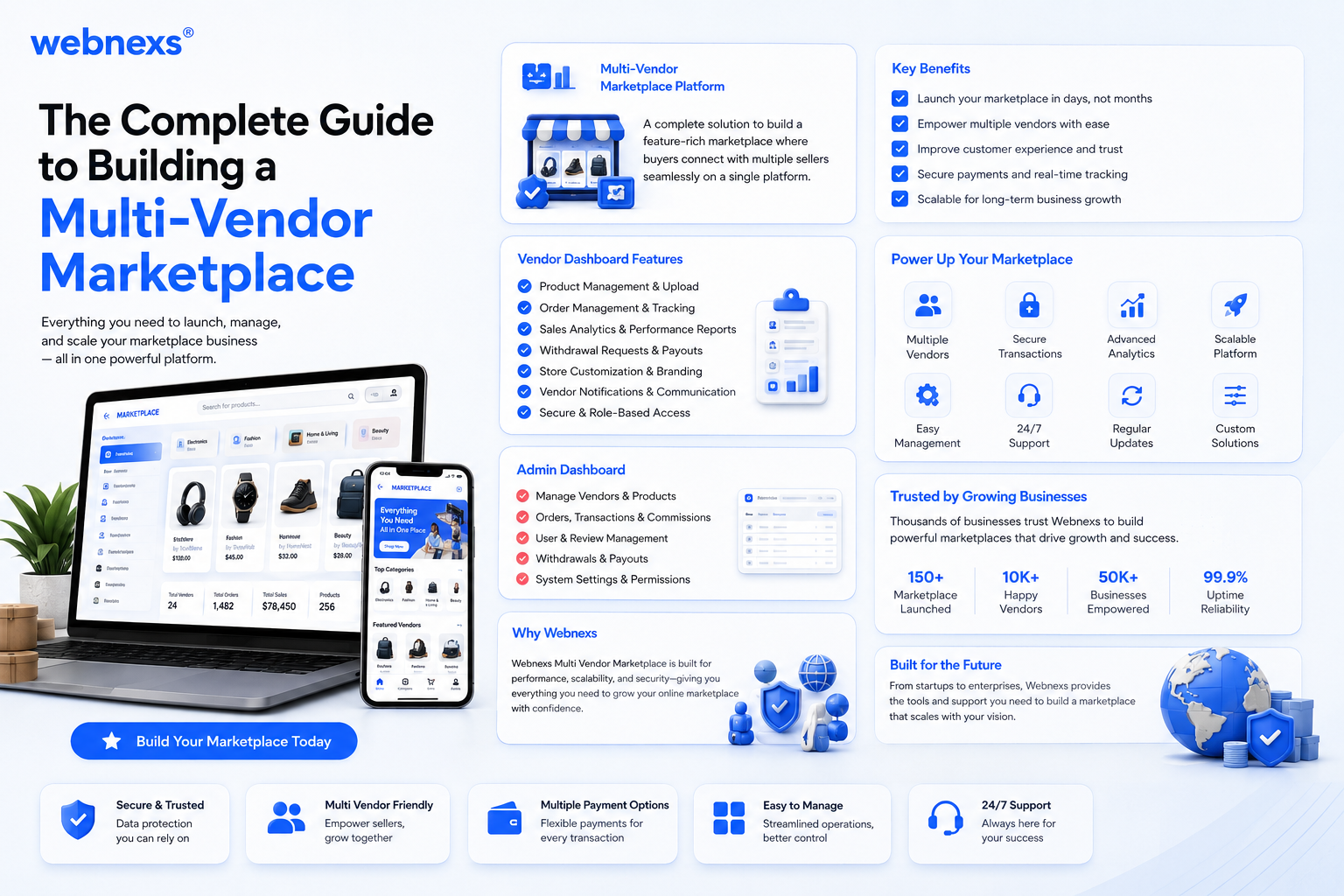
The e-commerce industry hasn’t just grown over the past decade, it’s exploded. And one business model keeps proving itself again and again on scalability and profitability: the multi vendor marketplace.
Industry reports put online marketplaces at more than 60% of global e-commerce sales. More than half. That alone makes this one of the most successful, fastest-growing digital business models around, no contest really. And that kind of growth is exactly why businesses of every size, big or small, keep pouring money into marketplace platforms built to connect multiple sellers and buyers through one shared destination.
Amazon. Flipkart. Etsy. eBay. Names everyone already knows. And every one of them has shown the same thing: multiple sellers can run under a single digital marketplace just fine, while customers walk away with more variety, better prices, and honestly, less reason to look anywhere else.
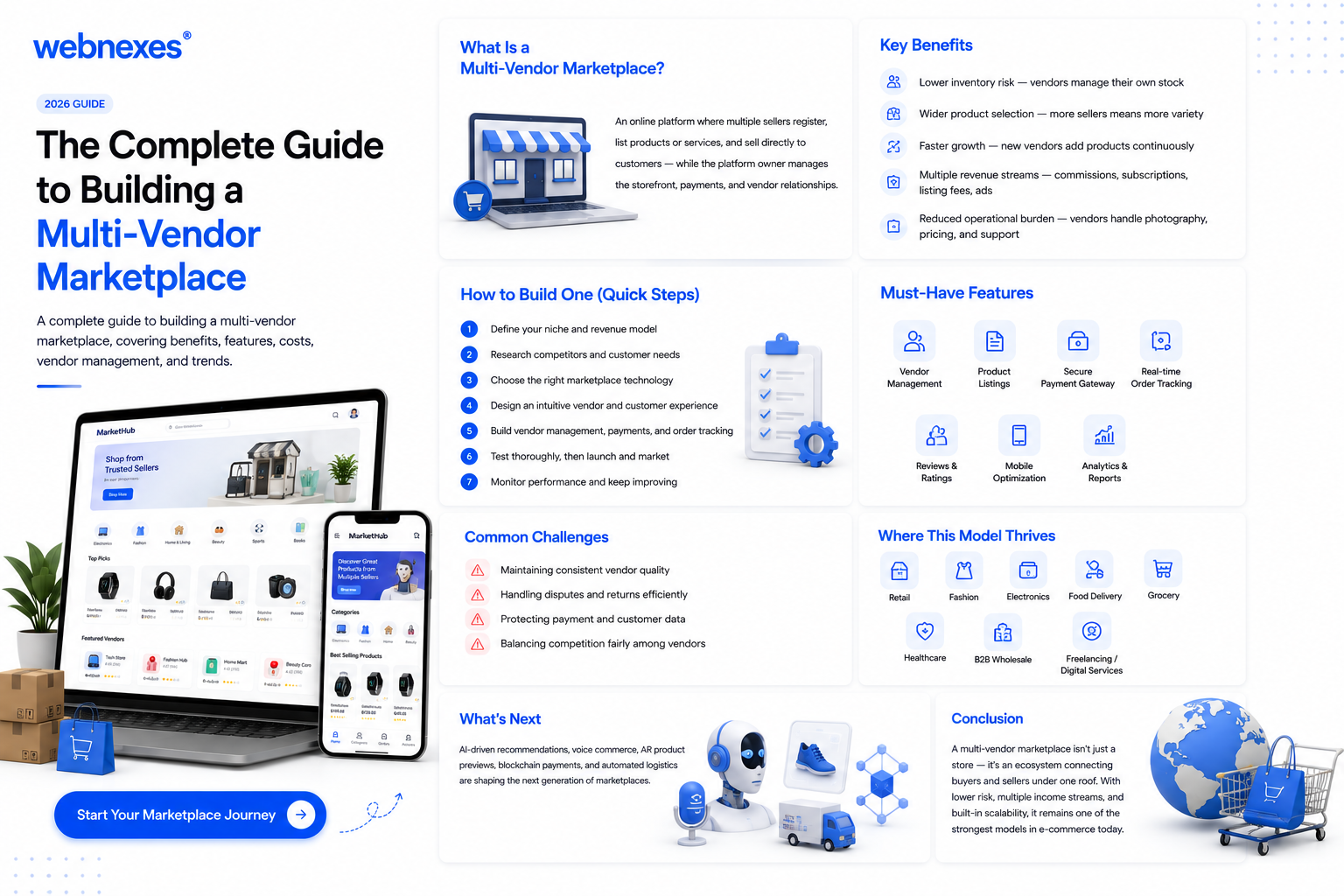
What Is a Multi Vendor Marketplace?
A multi vendor marketplace, put simply, is an online platform where multiple sellers can register, list their products or services, and sell straight to customers.
Multi Vendor Marketplace vs Single Vendor E-commerce: Which Is Better?
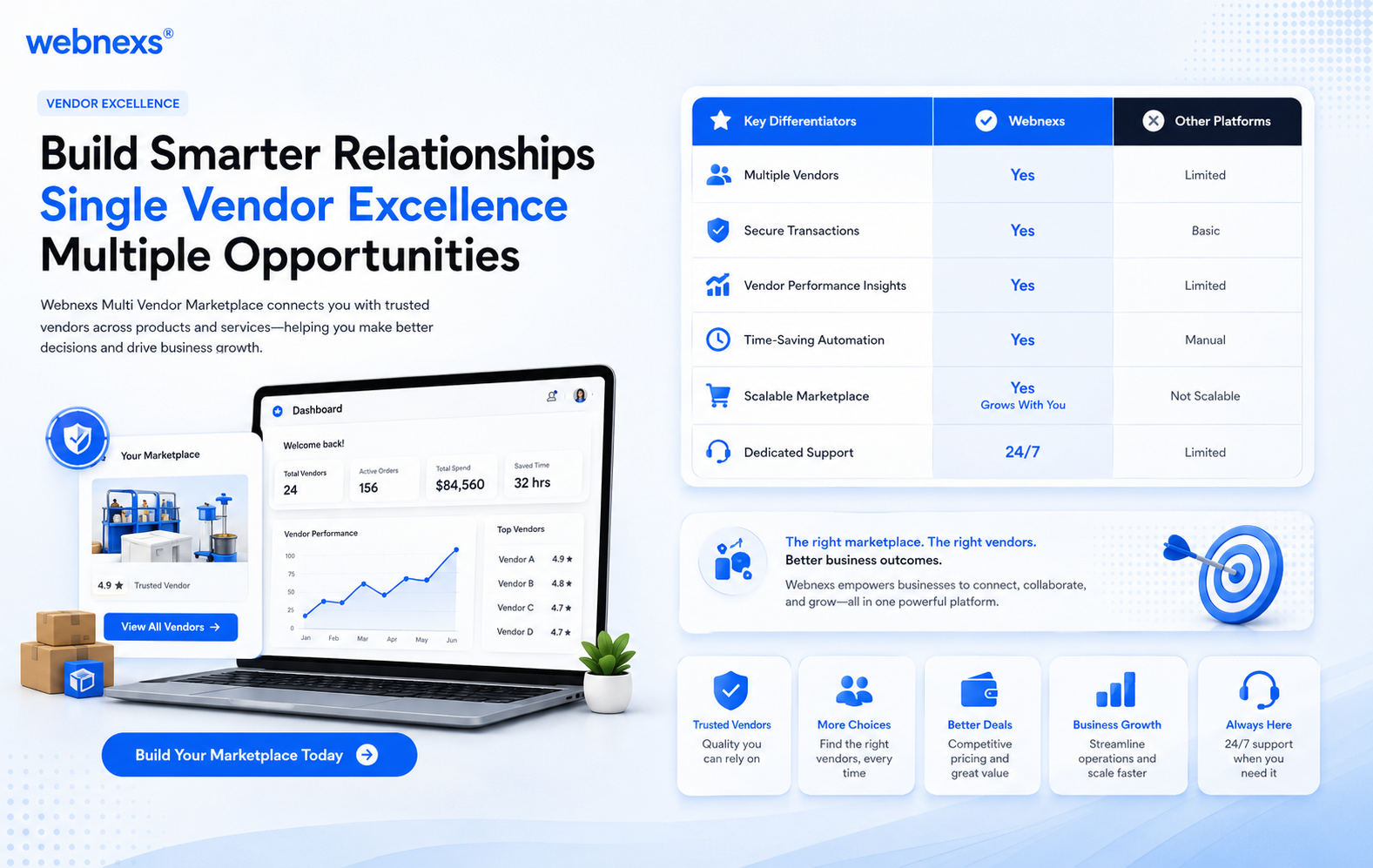
A multi vendor marketplace lets multiple sellers offer their products or services through one shared platform. A single vendor ecommerce website works completely differently, one business, owning and managing everything, selling only its own products.
| FEATURE | MULTI VENDOR MARKETPLACE | SINGLE VENDOR E-COMMERCE |
| Sellers | Multiple | Single |
| Product variety | High | Limited |
| Inventory responsibility | Vendors | Scale owners |
| Revenue sources | Commissions, subscriptions, ads | Product scales |
| Scalability | high | moderate |
For businesses seeking rapid growth, broader product catalogs, and multiple revenue streams, a Multi Vendor Marketplace often provides greater scalability and profitability.
BENEFITS OF MULTI VENDOR MARKETPLACE FOR ONLINE BUSINESS.
1. Lower inventory and operational costs, vendors carry the stock, not you, so you’re not footing that bill.
2. Wider product selection, more sellers means more variety, simple as that.
3.Faster growth through network effects, the platform compounds on itself as it scales.
4.More revenue, commissions and fees stacking up across every transaction.
5. Greater customer reach, real scalability built right in.
Multiple Revenue Streams
Commission fees. A cut of every sale, plain and simple.
Subscription or listing fees. Vendors pay for store access, or for getting featured.
Advertising revenue. Sponsored listings, banner placements, vendors pay to get seen.
Value-added services. Extra tools or support sold to vendors on top of everything else.
Reduced Operational Burden
Vendors handle their own photography, their own descriptions, their own pricing, and a lot of the time, customer service for anything product-specific too. Which frees you up. You get to focus on growth, trust, the platform experience as a whole, instead of getting stuck in day-to-day retail operations.
Key Benefits of a Multi Vendor Marketplace
1. Expanded Product Selection
A marketplace can offer thousands of products without requiring the owner to maintain inventory.
2. Faster Business Growth
New vendors continuously add products and services, helping the platform scale quickly.
3. Multiple Revenue Streams
Marketplace owners can earn revenue through:
- Vendor commissions
- Subscription fees
- Listing fees
- Advertising opportunities
- Premium vendor memberships
4. Reduced Inventory Costs
Vendors manage stock and fulfillment, reducing operational risks for marketplace owners.
5. Enhanced Customer Experience
Customers benefit from wider product choices, competitive pricing, and convenient shopping experiences.
| Role | Responsibilities | Benefit to the Marketplace |
|---|---|---|
| Customer Support Team | Deals with complaints, disputes, returns, whatever comes up | Keeps people trusting the platform |
| Marketing Team | SEO, social, paid ads, campaigns, you name it | More traffic, more customers, more buzz |
| Finance & Payment Manager | Watches the money, payouts, commissions, the reports | Nothing shady, everything adds up |
| Marketplace Owner/Admin | Runs the show, approves vendors, sets rates, oversees it all | Keeps the whole thing growing and profitable |
| Technology/Admin Team | Keeps things working, secure, updated | Smooth experience, nothing breaks |
| Vendor/Seller | Lists stuff, manages stock, ships orders | More products, more customers showing up |
| Delivery Partner | Gets the package there, on time, tracked | Orders actually arrive when they should |
| Customer/Buyer | Shops, pays, leaves a review | The reason any of this makes money |
How to Onboard and Manage Vendors Effectively
Successful marketplaces depend on quality vendors. A structured onboarding process helps maintain marketplace standards and improve seller performance.
Best practices include:
• Simplified registration and approval workflows
• Vendor verification and compliance checks
• Training resources and documentation
• Clear marketplace policies and guidelines
• Performance monitoring and seller ratings
Effective vendor management ensures a consistent customer experience and marketplace growth.
How to Build a Multi-Vendor Marketplace: Step-by-Step
Step 1: Define Your Business Model
Pick your niche. Figure out who you’re actually building this for. Decide how you’re making money, commissions, subscriptions, listing fees, whatever fits.
Step 2: Research the Market
Look at your competitors closely. Figure out what customers actually need. Then find what makes your platform different from everyone else doing the same thing.
Step 3: Select the Right Technology
Pick a platform, a framework, marketplace software, whatever supports proper multi-vendor functionality. This decision shapes everything that comes after it.
Step 4: Design the Marketplace
Build something intuitive. Easy navigation, for customers and vendors both, neither side should feel lost.
Step 5: Develop Vendor Management Features
Vendor registration. Profile management. Product listings. Inventory control. All of it needs to work smoothly, or vendors won’t stick around.
Step 6: Integrate Payment Systems
Secure payment gateways, non-negotiable. Automated commission distribution too, so nobody’s manually splitting payouts.
Step 7: Build Order and Shipping Management
Order tracking. Shipping options. Returns. Refunds. Customers expect all of this to just work, quietly, in the background.
Step 8: Add Customer Features
Product search. Reviews. Ratings. Wishlists. Customer support tools. These aren’t extras, they’re what keeps people coming back.
Step 9: Test the Platform
Usability testing. Performance testing. Security testing too, before launch, not after.
Step 10: Launch and Market the Marketplace
Get the word out. SEO, social media, email marketing, paid ads, whatever combination actually reaches your audience.
Step 11: Monitor and Improve
Track how things perform. Listen to user feedback. Keep enhancing features and security, this never really stops.
Follow these steps, and you end up with something that actually scales. Something people enjoy using too. A multi-vendor marketplace that works, for sellers, for customers, for everyone involved.
Multi Vendor Marketplace Development Cost: Complete Breakdown
What it costs to build a multi vendor e-commerce marketplace really comes down to a handful of things, platform complexity, custom features, integrations, how much scalability you actually need.
The big cost drivers usually look like this:
- UI/UX design
- Marketplace development
- Vendor management features
- Payment gateway integration
- Shipping integrations
- Mobile app development
- Hosting and maintenance
From there, it’s really a choice between ready-made marketplace solutions or going custom, and that decision comes down to your budget and where you’re trying to get to.
Essential Features of a Successful Marketplace
Vendor Management System
Sellers handle their own products, orders, inventory, earnings, all of it, independently. No middleman needed.
Product Management
Easy uploads. Clean categorization. Inventory tracking that actually keeps up.
Secure Payment Gateway
Safe transactions, every time. Commission calculation happens automatically, nobody’s doing that math by hand.
Challenges in Managing a Multi-Vendor Marketplace
While the model offers significant advantages, it also presents certain challenges:
Vendor Quality Control
Maintaining consistent product quality and service standards across multiple sellers can be difficult.
Customer Support
Disputes involving orders, returns, and deliveries require efficient support mechanisms.
Platform Security
Protecting customer data and payment information is critical for maintaining trust.
Competition Management
Balancing fair competition among vendors while ensuring profitability can be complex.
Mobile Optimization
Shopping should feel just as smooth on a phone as it does anywhere else. That’s the whole point here.
Analytics and Reporting
Real insight into how sales are going, how customers are behaving, how vendors are performing. All in one place.
Industries Benefiting from Multi-Vendor Marketplaces
The Multi-vendor marketplace model is widely used across industries such as:
- Retail and Consumer Goods
- Fashion and Apparel
- Electronics
- Food Delivery
- Grocery Services
- Healthcare Products
- B2B Wholesale
- Digital Services and Freelancing
Best Multi Vendor Marketplace Business Models Explained
A successful multi vendor marketplace can make money in a bunch of different ways, depending on which marketplace business model you actually go with.
- Commission-based model. A percentage off every sale, simple as that.
- Subscription-based model. Vendors pay monthly or annually for access.
- Listing fee model. Sellers pay just to get their products listed.
- Advertising model. Paid promotions, featured listings, vendors pay to get seen.
- Hybrid model. Mix a few of these together for better profitability overall.
The right business model depends on your target audience, industry, and business objectives.
Future Trends in Multi-Vendor Marketplaces
Technology keeps moving, and multi-vendor marketplaces are keeping up. A few things showing up more and more:
- AI-powered recommendations
- Personalized shopping experiences
- Voice commerce
- AR product visualization
- Blockchain-based payment systems
- Automated inventory and logistics management
None of this is just for show either. It’s making the customer experience better while making operations run a whole lot smoother behind the scenes.
Related Resources
- Multi Vendor Marketplace Development Services
- E-commerce Marketplace Development
- Single Vendor vs Multi Vendor Marketplace
- Vendor Management System
- Marketplace Success Story (Case Study)
- Order & Inventory Management Solutions
Related Reading: Take a look at our Multi Vendor Marketplace Development Services, and our Marketplace Success Story too, to see how businesses are actually building scalable online marketplaces and driving real growth.
Conclusion
A multi-vendor marketplace isn’t just an online store, it’s a whole ecosystem, buyers and sellers connected on one shared platform. And as customer expectations keep climbing, businesses really do need to stay sharp on innovation, performance, user experience, all of it, just to stay competitive. Worth checking out: 10 Common Mistakes to Avoid While Building an eCommerce Website, a good way to make sure your marketplace is actually built to last.
1. What is a multi-vendor marketplace?
A multi-vendor marketplace is an online platform where multiple sellers can register, list their products or services, and sell directly to customers through a single website or app
2. How does a multi-vendor marketplace work?
The marketplace owner provides the platform, vendors manage their products and orders, and customers browse, purchase, and review products. The platform typically earns revenue through commissions, subscriptions, or listing fees.
3. What are the benefits of a multi-vendor marketplace?
Key benefits include lower inventory costs, wider product selection, multiple revenue streams, faster business growth, improved scalability, and enhanced customer experience.
4. What is the difference between a single-vendor and multi-vendor marketplace?
A single-vendor store sells products from one business, while a multi-vendor marketplace allows multiple sellers to offer products on the same platform, creating greater variety and competition.
5. How much does it cost to build a multi-vendor marketplace?
The development cost depends on factors such as platform complexity, custom features, integrations, design requirements, and ongoing maintenance. Costs can range from a few thousand dollars for basic solutions to significantly more for enterprise-level marketplaces.