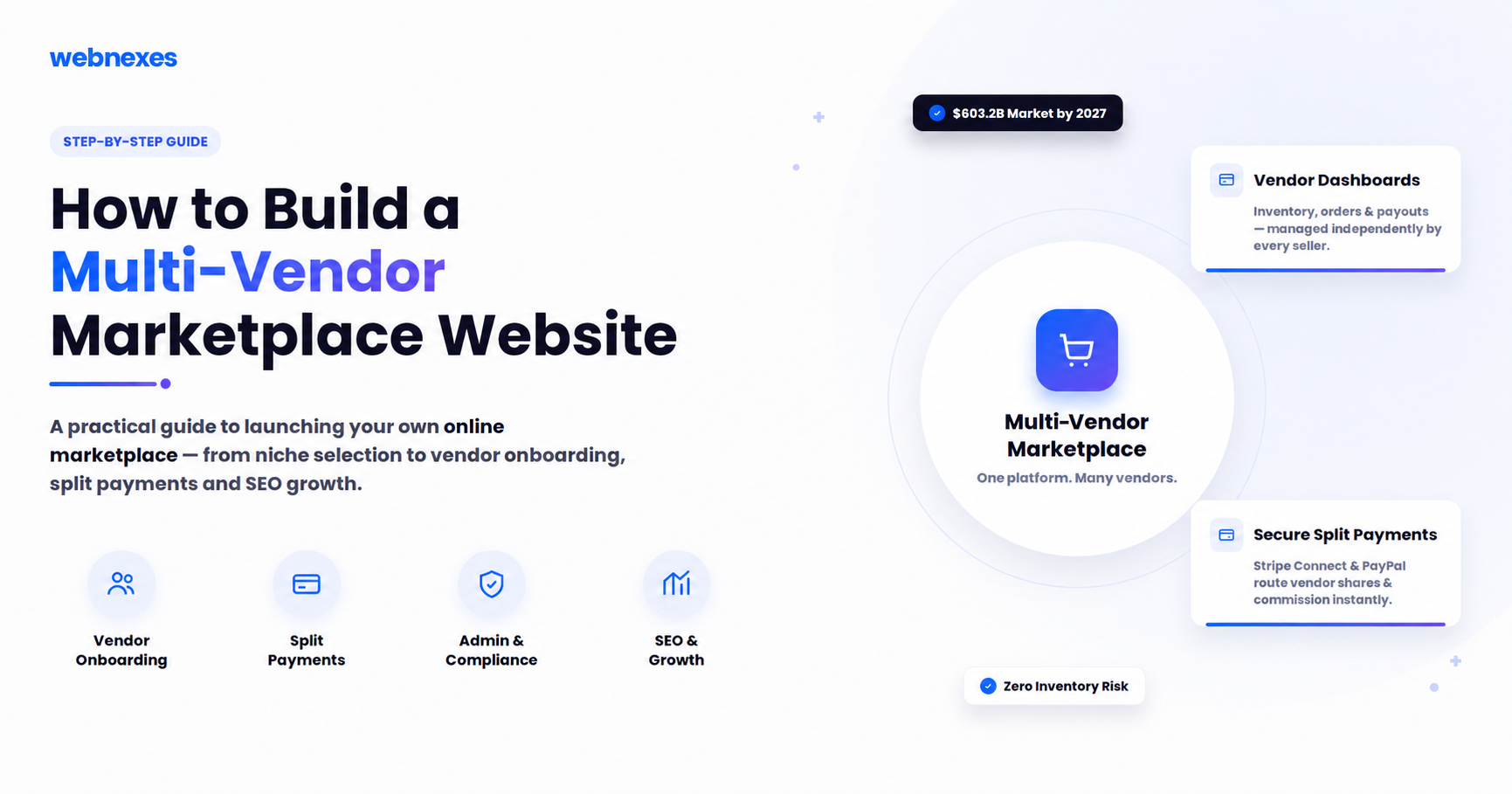
Building a multi vendor marketplace website might be one of the most scalable ways into e-commerce right now. No inventory to hold. None of that risk. And the numbers back it up, third-party marketplaces are projected to hit 59% of all global ecommerce by 2027. Amazon, Etsy, Flipkart they’ve already proven this model works at pretty much any scale. Startup founder or established retailer looking to expand? Doesn’t matter. This guide walks you through every step, from picking your niche to choosing the right platform, setting up payments, and optimizing for search.
If a marketplace isn’t the right fit and you need a simpler storefront instead, our roundup of the best Wix alternatives to build your website is worth a look.
What Is a Multi Vendor Marketplace Website?
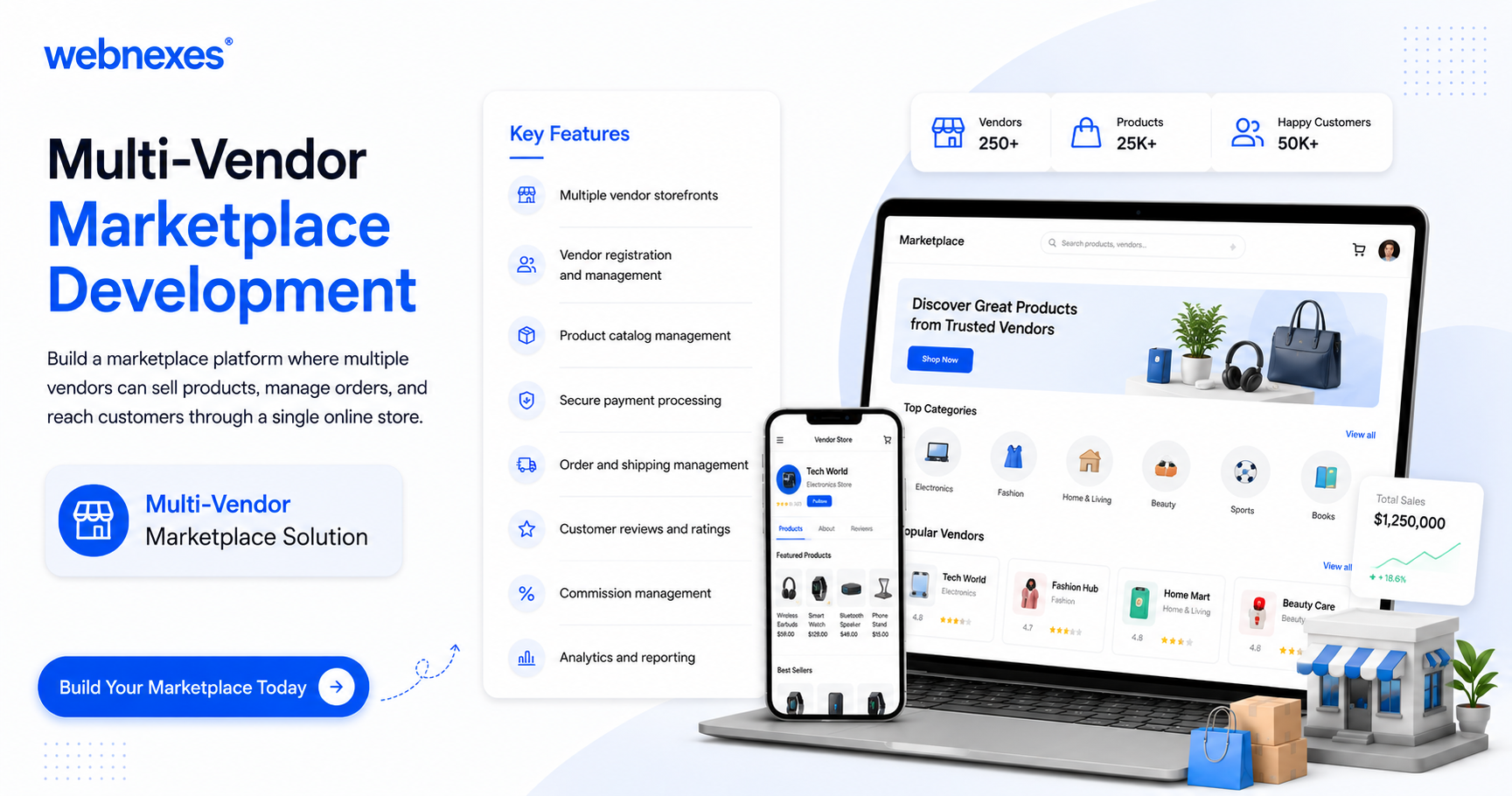
A Multi Vendor Marketplace website is basically an online platform where a bunch of independent sellers list and sell their own products or services, all under one shared storefront. The marketplace owner isn’t the one managing inventory here, that’s on the vendors. Instead, they provide the technology, traffic and trusted platform that enable buyers and sellers to connect and transact efficiently .
Unlike a single-store e-commerce site, a Multi Vendor marketplace needs additional infrastructure:
- Individual vendor dashboards and storefronts
- Centralized admin controls for approvals and quality
- Automated commission and payout splitting
- Vendor-specific reviews, ratings and order tracking
Why Build a Multi Vendor Marketplace in 2026?
The marketplace model continues to outperform standalone e-commerce stores on growth speed and capital efficiency. A few reasons founders keep choosing this model:
- Lower inventory risk — vendors manage their own stock and fulfillment.
- Faster catalog growth — every new vendor adds products without extra spend.
- Multiple revenue streams — commissions, subscriptions, listing fees and ads can all run together.
- Proven scalability. Amazon, Etsy, Flipkart, all of them started out narrow. Single category, focused niche. Expansion came later, once the model actually worked.
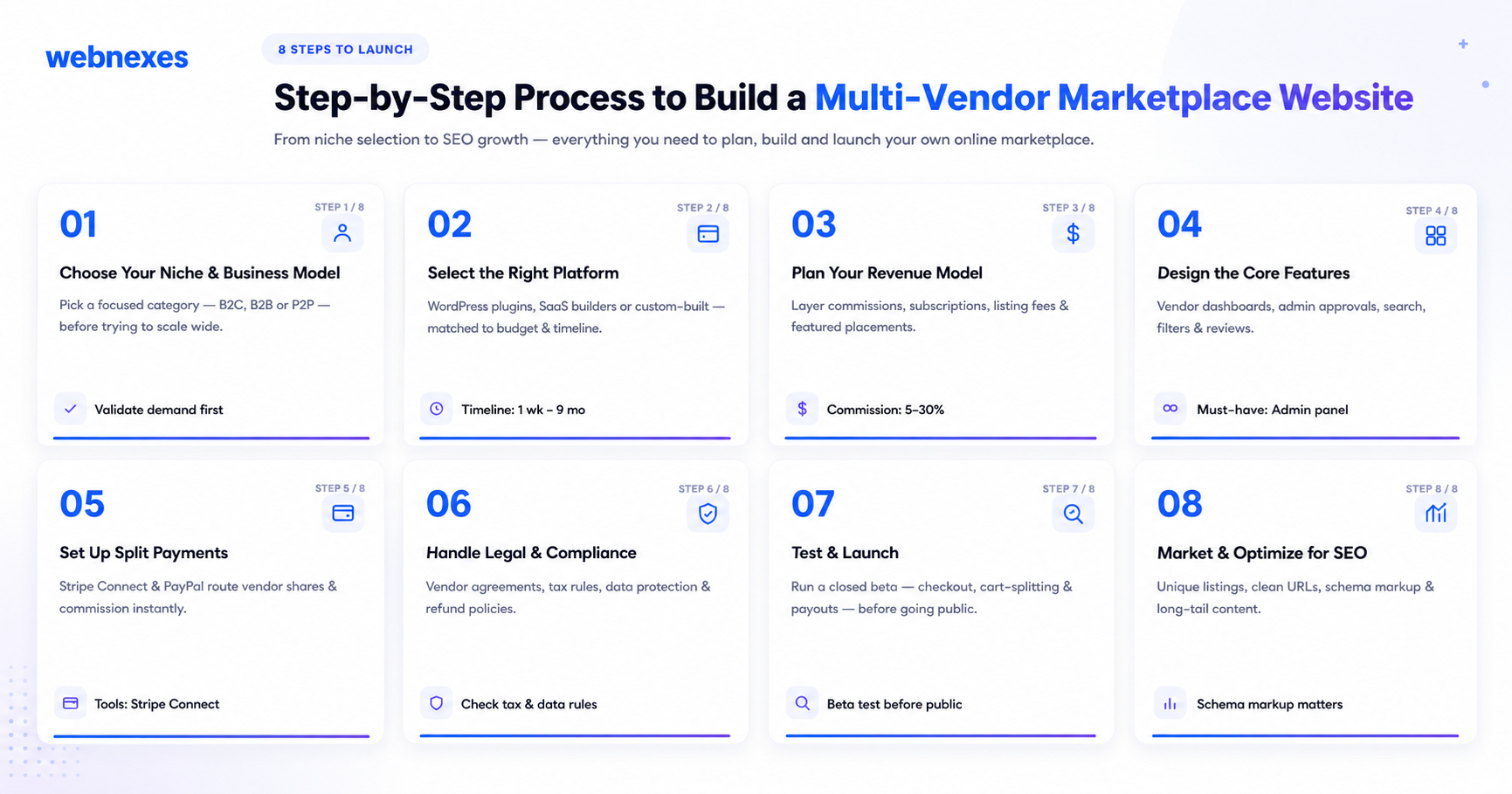
Step-by-Step Process to Build a Multi-Vendor Marketplace Website
1. Choose Your Niche and Business Model
“Amazon for everything.” That’s the trap. Try to be that on day one and most marketplaces never recover. Look at the ones that actually made it. Etsy stuck to handmade goods. Houzz went all in on home design. Freedomly picked niche services and stayed there. None of them started broad. They went narrow first, expansion came later, if it came at all.Before you build a single feature, answer this. B2C, B2B or peer-to-peer? Pick wrong and you’ll feel it. Everywhere.Your features, how vendors get onboarded, how much trust you need baked into the platform before day one even starts. That one decision touches almost everything else.
2. Select the Right Platform
Your platform choice determines your cost, timeline, and flexibility. Here’s how the main options compare:
| PLATFORM TYPE | EXAMPLES | BEST FOR | APPROX TIMELINE | CODING REQUIRED |
| WordPress Plugins | Dokan, WC Vendors | Budget-conscious startups | 2-6 weeks | Minimal |
| Shopify/WooCommerce Apps | Shipturtle, Multi Vendor Marketplace Pro+ | Brands scaling an existing store | 1-4 weeks | none |
| Dedicated SaaS Builders | Sharetribe, Nautical Commerce | Service or rental marketplaces | 2-8 weeks | Minimal |
| Self-Hosted Platforms | CS-Cart Multi-Vendor | Full source-code ownership | 1-3 months | some |
| Custom-Built from Scratch | In-house dev team | Highly specific workflows at scale | 4-9 months | Extensive |
Want full control? Skip the recurring platform fees? Then self-hosted or fully custom is your answer. But if speed matters more than control, if getting to market fast is the actual priority, no-code marketplace apps will get you live in a few weeks. Sometimes less.
3. Plan Your Revenue Model
Most profitable marketplaces layer more than one income stream:
- Commission per sale — typically 5–30%, depending on category (Etsy charges 6.5%).
- Subscription or listing fees. Vendors pay a flat monthly rate just to access the platform. Amazon’s Professional seller plan works this way.
- Pay-per-listing. A small fee every time a vendor adds a new product. You’ll see this a lot in peer-to-peer marketplaces.
- Featured placements or ads. Want better visibility? Vendors pay extra for that, search results, category pages, wherever it gets eyes on the product.
4. Design the Core Features
At minimum, your Multi Vendor marketplace website needs:
- Vendor registration, verification and onboarding workflow
- Individual vendor dashboards for inventory, orders and payouts
- A centralized admin panel for approvals and dispute resolution
- Search, filtering and category navigation for buyers
- Reviews and ratings tied to each vendor, not just the platform
5. Set Up Payments and Commission Splitting
This is the part that separates marketplace software from a normal online store. One thing you can’t skip is a payment gateway built for split payments. This is what lets a single customer order automatically send the right share to each vendor while your commission gets deducted on the spot. Good news, though. You don’t have to build this from scratch. Stripe Connect handles it. So does PayPal for Marketplaces. Platforms like Shipturtle and Sharetribe too, right out of the box, no extra work needed.
6.Legal and Compliance: Get This Right Early
Before you launch, take the time to get the legal groundwork in order. That means vendor agreements, figuring out who’s responsible for collecting taxes, putting solid data protection policies in place and setting clear rules for refunds and disputes. It’s not the most exciting part of building a marketplace, but skipping it tends to cause real problems later.Marketplace tax rules vary by region and product type, so this is one area worth getting right before you onboard your first vendors, not after.
7. Test and Launch
Before opening registration to everyone, run a closed beta with a small group of vendors first. Walk through the entire buyer journey yourself: browsing, checkout, how the cart splits across multiple vendors and whether payouts process correctly. Whatever friction you find, fix it now, before you start scaling traffic, not after.
8. Market and Optimize for SEO
Once you’re live, organic visibility starts mattering just as much as paid ads. Maybe more. Get your vendors writing unique product descriptions, duplicate listings will tank your rankings fast. Keep URLs clean. Add schema markup, that’s how you show up with rich snippets. Build a blog too, one that actually targets the long-tail questions your buyers are typing into Google. The real compounding effect though? Internal linking. Tie your vendor pages, categories and blog content together and your SEO just keeps building on itself, month after month.
Essential Features Every Multi Vendor Marketplace Website Should Have
A successful multi vendor marketplace website comes down to making buying and selling feel effortless for both customers and vendors. At a minimum, that means vendor registration, product management, secure payment gateways, order tracking, customer reviews, inventory management and an admin dashboard to tie it all together. On top of that, mobile responsiveness, solid search filters and built-in analytics go a long way toward improving the experience for everyone while making it easier for marketplace owners to actually run the thing day to day.
How Much Does It Cost to Build a Multi Vendor Marketplace Website?
What does it actually cost to build a multi vendor marketplace website? Comes down to a few things. How complex the platform needs to be. Which features are non-negotiable. How much customization you’re after, how many third-party integrations you’re pulling in. A basic solution costs a lot less than a fully custom build loaded with bells and whistles, that part’s obvious. But development isn’t where the costs stop. UI/UX design, payment integration, mobile app work, hosting, security, ongoing maintenance, all of it adds up. That’s what shapes the final number.
Best Multi Vendor Marketplace Business Models
Get the business model wrong and nothing else about your marketplace really matters. It won’t last. Most multi vendor marketplaces make their money some mix of commission per sale, vendor subscriptions, listing fees, maybe ads too. Rarely just one of those. They blend whatever actually works. Which combo makes sense for you? Depends on who you’re selling to, what industry you’re in, and honestly, where you want this thing to end up a few years from now.
How to Manage Vendors Successfully in a Multi Vendor Marketplace
Good vendor management is really what separates a high-quality marketplace from a mediocre one. Clear onboarding. Policies that actually make sense. Performance checked regularly, not just at sign-up. Support that shows up when vendors actually need it. Do that, and trust builds on its own, sellers perform better too. Give them a dashboard that’s actually easy to use, throw in some real insights now and then, and engagement tends to follow. Partnerships that last usually start exactly that way.
Common Challenges in Multi Vendor Marketplace Development
Building a multi vendor marketplace isn’t without its headaches. Multiple vendors to manage. Product quality that’s hard to keep consistent. Transactions that need to stay secure, disputes that need handling and a platform that has to scale as things grow. Real challenges, all of them. The good news? They’re manageable. Picking the right technology helps. Strong security measures help more. And responsive customer support backing it all up is usually what actually gets a marketplace through these hurdles and into something that lasts.
Conclusion
Boil it all down and building a multi vendor marketplace website comes down to a handful of things. Pick a focused niche. Choose a platform that actually fits your budget and timeline. Get commission-based payments set up right, not just working, right. Invest early in SEO and the vendor experience too, don’t leave that for later. Nail those and there’s no reason your marketplace can’t scale the same way Etsy, Flipkart, and countless niche platforms have.
How much does it cost to build a multi-vendor marketplace website?
Costs range from a few hundred dollars for a no-code plugin setup to $50,000+ for a fully custom-built platform, depending on features and scale.
How long does it take to launch a multi-vendor marketplace?
A no-code or plugin-based marketplace can launch in 2–6 weeks, while a custom-built platform typically takes 4–9 months.
Which is better: WordPress, Shopify, or a custom build for a marketplace?
WordPress (Dokan, WC Vendors) suits budget-conscious launches, Shopify apps suit brands scaling an existing store and custom builds suit businesses with highly specific workflows at higher budgets.
How do multi-vendor marketplaces handle vendor payments?
Most use split-payment tools like Stripe Connect or PayPal for Marketplaces, which automatically divide each order between the vendor and the platform’s commission.
What’s the most common revenue model for a multi-vendor marketplace?
Commission per sale (typically 5–30%) is the most common, often layered with subscription or listing fees as the platform grows.
Do I need coding skills to build a multi-vendor marketplace?
No. no-code platforms like Shipturtle, Dokan and Sharetribe let you launch without writing code, though custom builds still require a development team.