Multi vendor marketplace business models aren’t all built the same. Pick the wrong one, and it won’t show up right away. It shows up six months in, when you’re rebuilding half your platform because the model never fit how people actually wanted to buy or sell. Marketplaces now make up roughly 62% of global retail e-commerce, and that didn’t happen by accident. A handful of business models, repeated across thousands of platforms, simply work. This guide breaks down the main types, how each one makes money, and which one fits which kind of business.
What Is a Multi Vendor Marketplace Business Models, Really?
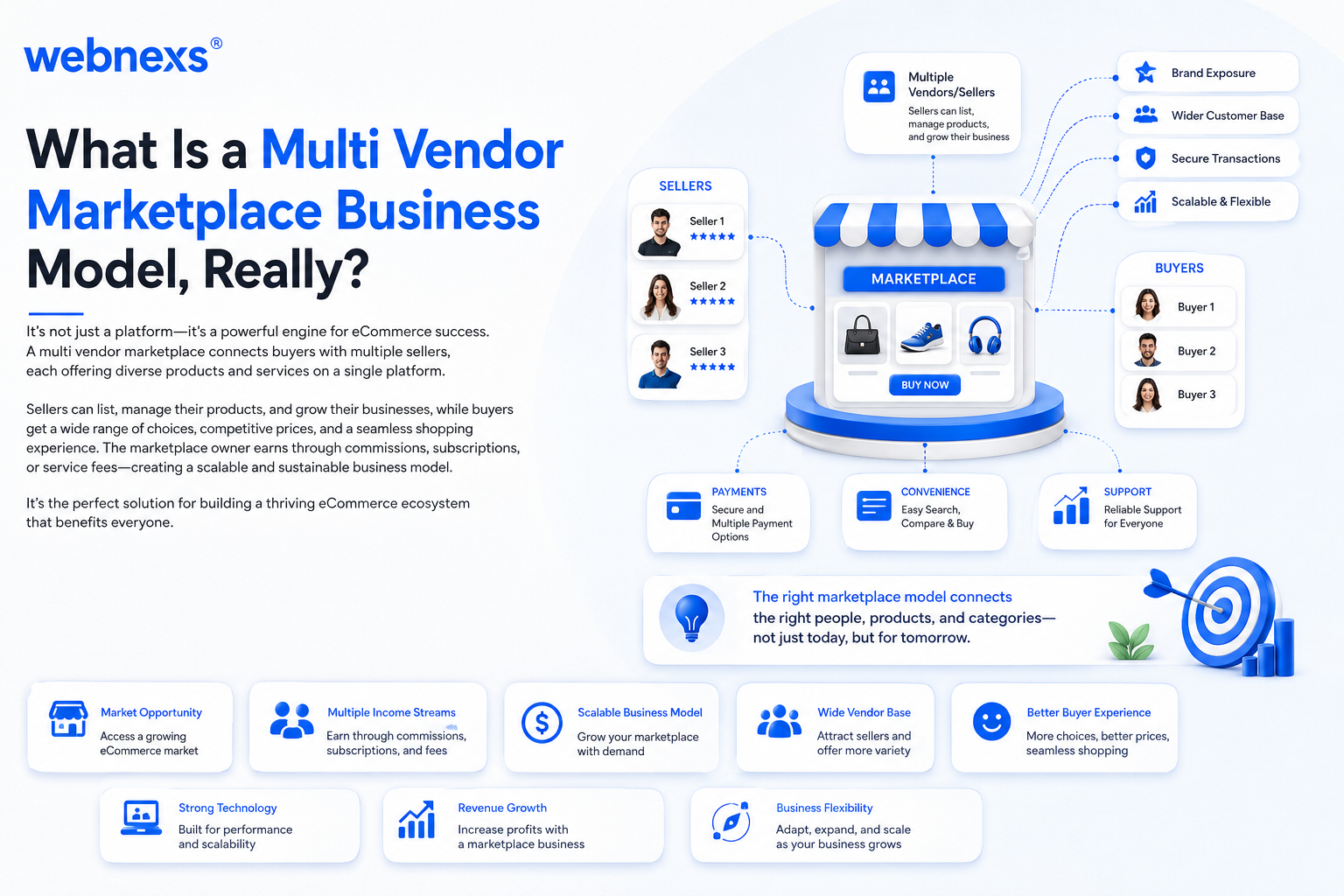
It’s not just “a website where people sell stuff.” A business model, in this context, is the combination of who’s selling, who’s buying, and how the platform takes its cut. Get any one of those three wrong, and the rest of the platform won’t save you.
There are two layers to get right here. First, the type of marketplace, who’s on each side of the transaction. Second, the revenue model, how the platform actually gets paid.Most guides mix these together. We won’t, since that’s how founders end up copying a competitor’s pricing without checking if it fits.
It’s worth saying upfront: there’s no “best” model in the abstract. There’s only the model that fits your specific buyers, sellers, and category. A model that works beautifully for handmade jewelry will fall apart for industrial procurement, and vice versa.
Types of Multi Vendor Marketplace Business Models
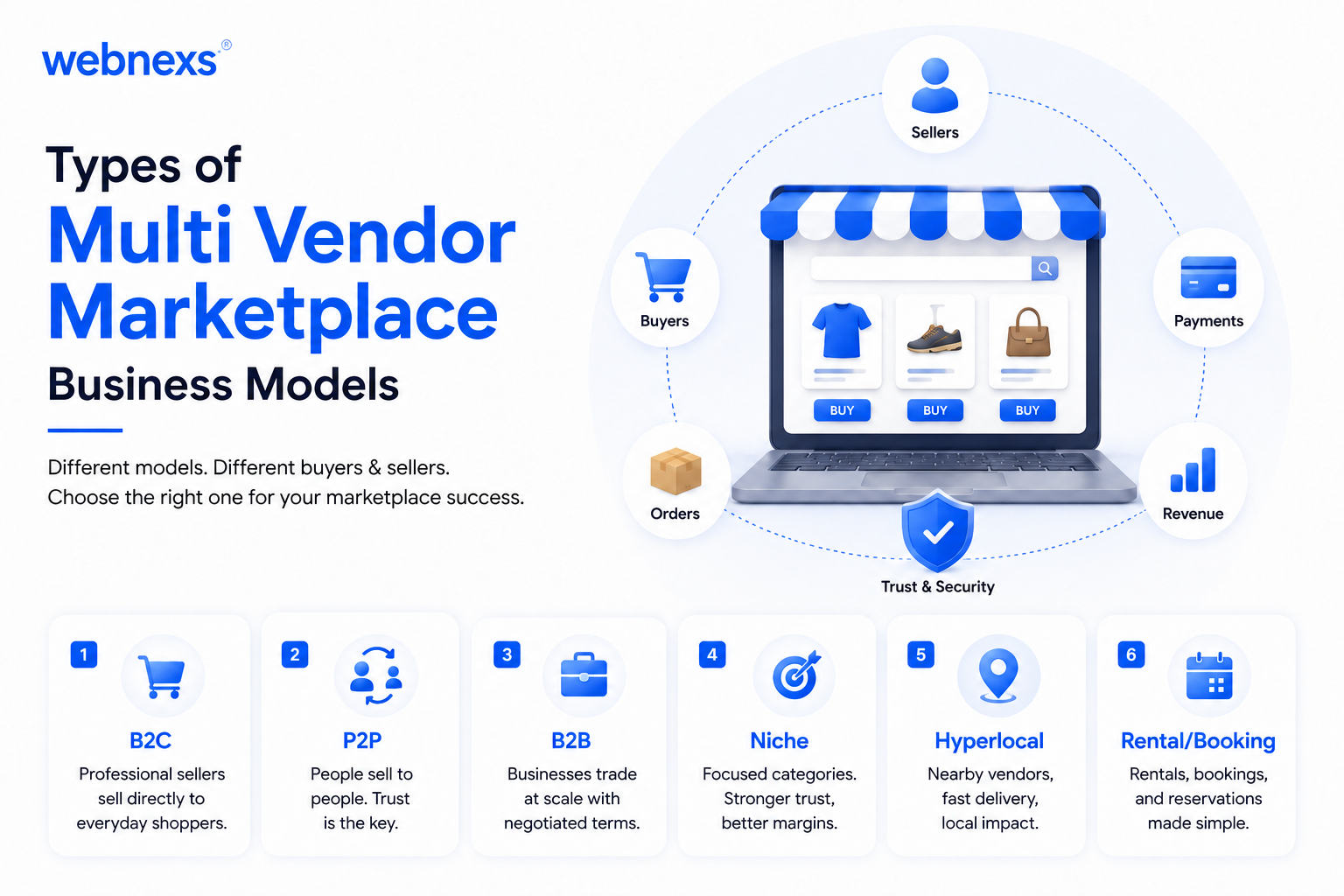
1. B2C (Business-to-Consumer) Marketplaces
Professional sellers, selling straight to everyday shoppers. That’s the model Amazon, Flipkart, and Zalando all run on. It’s the one most people already know how to use without thinking twice, just because they’ve done it a hundred times before.That is why it is usually easy to get started with this model.
This way of doing business works well for things like clothes, electronics and other everyday items. When people buy these things they want to get them and they want to be able to return them easily if they do not like them. They also want the process of paying for them to be simple. The problem, with this model is that there are a lot of people doing the same thing. To be different people who sell things might try to pick the items they sell carefully or they might try to charge lower prices or they might try to sell things that the big companies are not selling.
2. P2P (Peer-to-Peer) Marketplaces
Regular people sell stuff to regular people.
EBay, Poshmark and Facebook Marketplace are good examples of this.
The main job of these platforms is to help people trust each other.
Ratings, payment protection and dispute resolution help two strangers feel comfortable giving each money.
P2P is good for resale, second-hand items and things where the seller is not a business.
They are getting rid of things in their closet or garage.
Individual sellers do not have much stuff or reliability as professional sellers.
So P2P platforms need to focus on building trust with things, like verifying sellers, secure messaging and clear refund policies before they need anything.
3. B2B (Business-to-Business) Marketplaces
B2B marketplaces aren’t just “Amazon for businesses,” and that distinction matters more than people think. They need corporate accounts set up properly. They need RFQs built into the workflow. They need ERP integrations that consumer-facing marketplaces never have to worry about, not even a little. Pricing in this space is often negotiated rather than fixed in stone, and a single buyer account might actually represent an entire organization, complete with multiple approvers, not just one person sitting there with a credit card ready to go. This added complexity is exactly why B2B marketplaces tend to land higher average order values, but the tradeoff is slower, more deliberate sales cycles compared to what you’d see on the B2C side of things.
4. Niche Marketplaces
Forget selling everything to everyone. Niche marketplaces go deep on one category instead. Etsy did it with handmade goods. Houzz did it with home design. Neither one tried to be Amazon, and that’s exactly why they worked.
Smaller audience, sure. But the trust runs deeper. The community’s tighter. Margins per transaction usually end up better too. Sellers in a specialized category don’t have a dozen other platforms competing for them, so they stick around. That loyalty just keeps compounding, something general marketplaces almost never pull off.
5. Hyperlocal Marketplaces
Nearby vendors, nearby customers, usually within one city or a tight delivery radius. Food delivery, grocery, pharmacy services, this model runs all of it. Speed matters more here than almost anything else. More than selection. Sometimes more than price.
These marketplaces live or die on execution, plain and simple. A great app with slow delivery loses to a mediocre app that’s fast. Every time. Hard model to run well, no question. But nail the local execution and you’ve got something competitors can’t just copy overnight.
6. Rental and Booking Marketplaces
No product changes hands here, not permanently anyway. Just availability calendars, booking windows, deposits, scheduling. Equipment rental. Real estate. Service bookings. The sharing economy pushed this into the mainstream, and it never really slowed down.
Here’s what makes it different: time. A sale is one moment, done. A booking has a start date, an end date, a deposit that has to be held and released right. More moving parts than other marketplace types deal with. But also recurring revenue that a one-time sale just can’t touch
| MODELS | EXAMPLE | BEST FOR | TRUST REQUIREMENT |
| B2C | Amazon, Flipkart, Zalando | General retail, fashion, electronics | Moderate |
| P2P | eBay, Poshmark, Facebook Marketplace | Resale, secondhand goods | High |
| B2B | Industrial supplier networks | Wholesale, procurement | Moderate, contract-based |
| Niche | Etsy, Houzz | Specialized categories | Moderate to high |
| Hyperlocal | Food and grocery delivery apps | Local, fast-delivery goods | Low to moderate |
| Rental/Booking | Equipment and property rental platforms | Bookings, scheduling, deposits | High |
How Multi Vendor Marketplaces Actually Make Money
Picking your marketplace type answers who’s involved. Picking your revenue model answers how you actually get paid. The two are separate decisions, and most successful marketplaces don’t rely on just one revenue stream, because depending on a single source of income tends to make the entire business fragile.
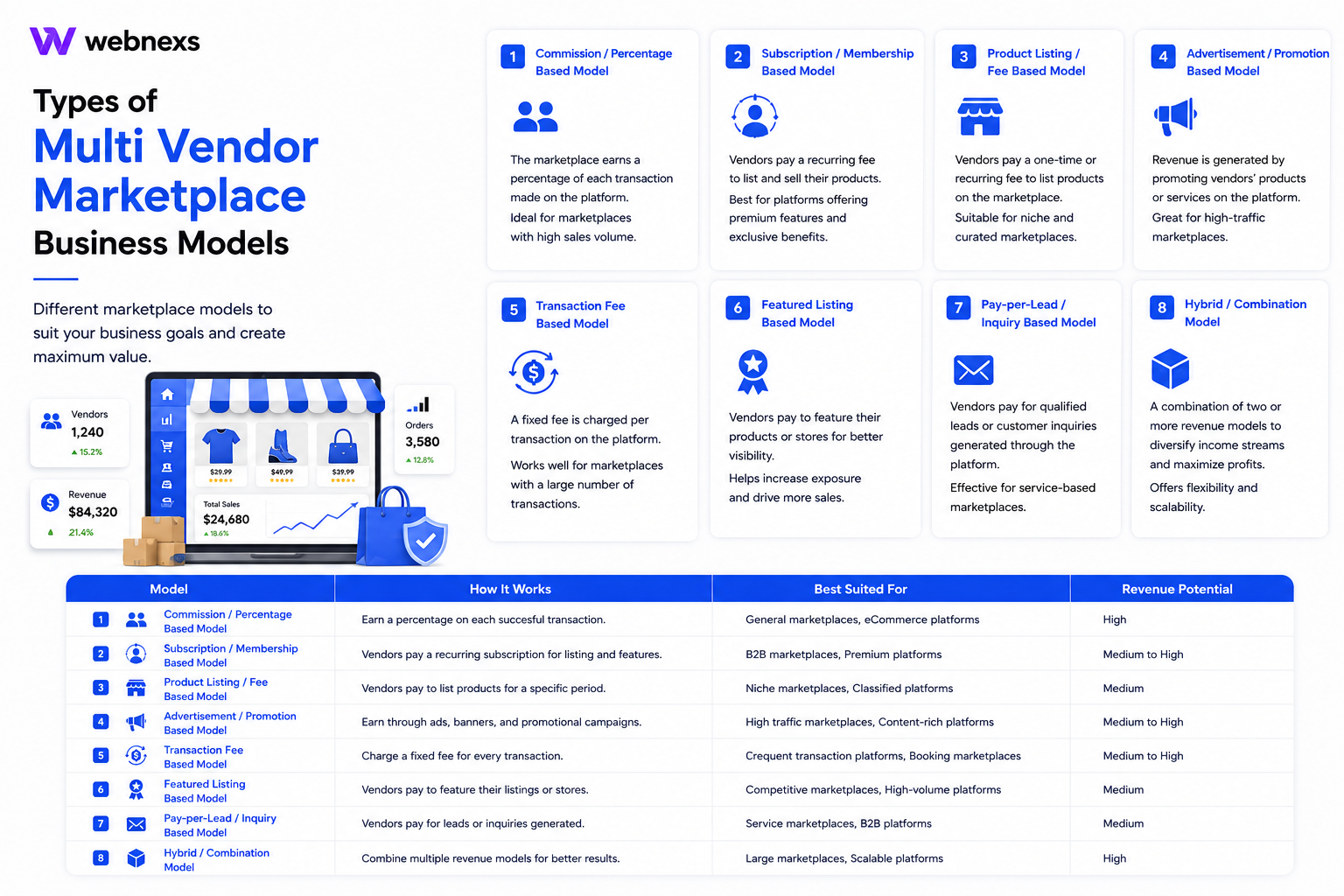
Commission per sale.
The most common model by far. Typically 5 to 30%, depending on category, Etsy charges around 6.5%, for instance. Take a cut of every transaction, and your revenue scales directly with marketplace activity. The appeal is obvious: no commission without a sale, so vendors rarely feel like they’re paying for nothing.
Subscription or listing fees.
Vendors pay a flat fee just for platform access, similar to Amazon’s Professional seller plan. This gives you predictable revenue that doesn’t depend on transaction volume, which is especially valuable in the early days when sales are inconsistent and unpredictable.
Pay-per-listing.
A small fee every time a vendor adds a new product. Common in peer-to-peer marketplaces where transaction commissions alone wouldn’t be enough, since individual sellers may only complete a handful of sales a year.
Featured placements and advertising.
Vendors pay extra for visibility, better search placement, homepage features, sponsored banners. This becomes a meaningful revenue stream once a marketplace has real traffic to sell, though it only works once you’ve actually built an audience worth advertising to.
Marketplaces that combine subscriptions with commissions tend to outperform commission-only models on profit margin.Sticking to just one revenue stream is one of the more common mistakes new marketplace owners make. Not because it’s the smartest move. Just the easiest one to set up.
Common Mistakes When Choosing a Business Model
Even experienced founders mess this up more often than you’d think. A few patterns keep showing up.
Copying a competitor’s model without checking if it actually fits. Etsy charges a certain commission rate, sure. Doesn’t mean that rate works for your category. Margins, average order values, vendor expectations, all of it shifts wildly from one industry to the next.
Underestimating trust requirements. P2P and rental marketplaces especially get this wrong. Founders build the transaction flow first and treat trust features, reviews, verification, dispute resolution, as an afterthought, when really they should be considered core infrastructure from day one.
Choosing complexity before validating demand. B2B and enterprise-style marketplaces are tempting because of higher order values, but they also require far more technical and operational investment upfront. Plenty of founders sink months into approval workflows and ERP integrations before confirming anyone actually wants to buy through the platform at all.
Sticking with one revenue stream for too long. Commission-only is simple to launch, sure. But it’s fragile. And plenty of marketplaces know they need a second income stream, they just wait way longer than they should to actually add one.
Advantages and Disadvantages of Multi Vendor Marketplace Business Models
Every model covered above comes with real tradeoffs. Weighing them honestly upfront saves a lot of pain later.
Advantages
Lower inventory risk. Across nearly every model, vendors carry their own stock. The platform owner isn’t the one sitting on unsold inventory or tying up capital in goods that might not sell.
Multiple revenue streams. As covered above, commissions, subscriptions, listing fees, and advertising can all run alongside each other, giving marketplaces far more financial flexibility than a single-vendor store relying on product margin alone.
Faster catalog growth. Every new vendor who joins brings their own products. The catalog expands without the platform owner sourcing a single new item.
Network effects. More vendors attract more buyers, and more buyers attract more vendors. This self-reinforcing cycle is part of why marketplaces tend to scale faster than traditional e-commerce stores once they reach a certain size.
Resilience to individual vendor loss. If one vendor underperforms or leaves, the marketplace isn’t dependent on them the way a single-supplier business would be. Other vendors keep the platform running.
Disadvantages
The chicken-and-egg problem. You need buyers and sellers both, but getting one side to show up without the other already there? Genuinely hard. Plenty of marketplaces never make it past this stage.
Trust isn’t automatic. You have to build it. Especially with P2P and rental models, where buyers and sellers are often complete strangers. Reviews, verification, dispute resolution, none of that is optional. Skip it and transactions just stop happening.
Things get more complicated as you grow. Payment splitting, commission math, vendor support, disputes, all of it gets harder with more vendors. Twenty vendors, no problem. Two thousand? That breaks fast without the right systems in place.
Margins can run thin. Especially in B2C, where competition keeps commission rates low just to keep vendors around. Profitability often depends on hitting real volume first.
Which Business Model Should You Choose?
Honestly, there’s no one right answer. Depends on your audience. Your category. How much operational complexity you can actually stomach.
Selling physical products to everyday people? B2C, well-worn path, plenty of company. Solving for trust between strangers? P2P fits better. Serving procurement teams who need approval chains and negotiated terms, not just an add-to-cart button? That’s B2B territory. Want something defensible instead of just big? Start niche.
Plenty of marketplaces didn’t start where they ended up. Amazon began as a bookstore. One category. Expansion came way later, once the model actually proved itself. Same pattern keeps repeating. Validate narrow first. Expand once the fundamentals hold up. Don’t try to serve everyone from day one.
Conclusion
Boil it down and choosing the right multi vendor marketplace business model really comes down to two things. Who’s actually transacting on your platform. And how you’re getting paid for making that happen. Nail those early and everything else, your features, your vendor onboarding, your growth strategy, gets a lot easier to build around. Get them wrong, though, and no amount of clever design fixes that later.
What’s the most profitable business model?
There’s no single “most profitable” model. It depends on category and execution, but marketplaces that combine commission with at least one other revenue stream, like subscriptions or advertising, tend to outperform commission-only platforms on margin.
Can a marketplace use more than one business model at once?
Yes, and many do. A platform might run simultaneously, or blend commission fees with subscription tiers for premium vendors. Flexibility tends to matter more than rigid commitment to one model.
What’s the difference between a B2C and P2P marketplace?
B2C marketplaces feature professional vendors selling to everyday consumers, with an emphasis on fast shipping and polished checkout. P2P marketplaces connect individuals with each other, where trust-building features like ratings and payment protection matter more than logistics.
Do niche marketplaces make less money than general marketplaces?
Not necessarily. Niche marketplaces often see stronger customer loyalty and higher margins per transaction, even with a smaller total audience, because they build deeper trust within a focused community.
How do I know which marketplace type fits my business idea?
Start with who’s actually going to transact on the platform. If they’re professional sellers serving everyday consumers, B2C likely fits. If individuals are selling to other individuals, lean P2P. If your buyers are companies with procurement processes, you’re looking at B2B. The type usually becomes obvious once you’re honest about who’s really on each side of the transaction.